
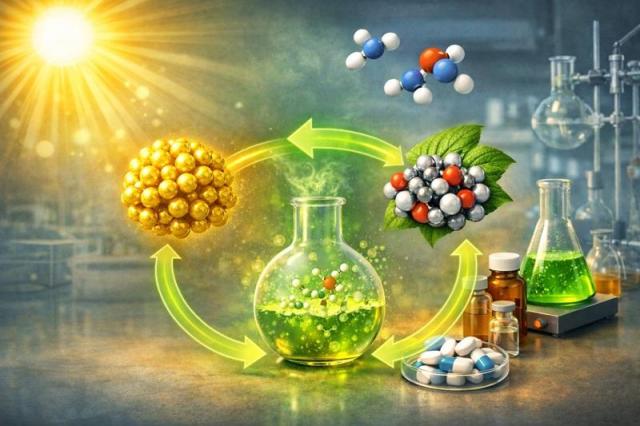
SEOUL, March 30 (AJP) - A research team in South Korea has developed a way to produce essential pharmaceutical raw materials using only sunlight and ambient air, potentially slashing carbon emissions in the chemical industry. This breakthrough simplifies the manufacturing of complex drugs by replacing traditional, waste-heavy chemical processes with a sustainable loop that relies on natural elements.
The Korea Advanced Institute of Science and Technology (KAIST) announced on March 30, 2026, that a team led by Professor Han Sang-woo of the Department of Chemistry successfully combined two different types of catalysts into a single system. The method integrates a solid silver-based catalyst with a liquid organic photocatalyst known as DDQ.
In traditional chemical manufacturing, companies often have to choose between catalysts that are precise but disposable and those that are reusable but less efficient. The KAIST team bypassed this trade-off by creating a system where the two catalysts work together to drive reactions that were previously difficult to sustain.
The researchers used this hybrid platform to create amines, which serve as the primary building blocks for various medicines. By relying on sunlight and air rather than harsh chemical additives or high-pressure environments, the process produces almost no waste other than water.
Existing organic photocatalytic methods often require additional chemicals to reset the catalyst after each use, or they suffer from slow reaction speeds when exposed to oxygen. To solve this, the team designed a circular loop where the byproducts of the reaction naturally reactivate the catalysts.
Sunlight provides the energy to start the reaction, while oxygen from the air acts as the agent that "recharges" the catalysts for the next cycle. This allows the system to run continuously without the need for constant chemical intervention.
To prevent the two different catalyst types from interfering with each other, the researchers added lithium perchlorate (LiClO4). This additive stabilizes the silver particles and the organic molecules, ensuring the system remains active for longer periods.
"This study is the first case of successfully applying inorganic photochemical loop technology to precision organic synthesis," Professor Han Sang-woo said. "By merging the advantages of different catalytic systems, we have made a significant step toward reducing the carbon footprint of the chemical industry."
Professor Han Sang-woo noted that the breakthrough provides a new way to manufacture high-value compounds like pharmaceutical ingredients through more sustainable methods.
The study, with KAIST researcher Baek Jin-uk as the lead author, appeared in the Journal of the American Chemical Society (JACS) on March 18, 2026.
(Reference Information)
Journal/Source: Journal of the American Chemical Society
Title: Merger of heterogeneous and homogeneous photocatalysis for arene C–H Amination
Link/DOI: https://doi.org/10.1021/jacs.5c20824

Copyright ⓒ Aju Press All rights reserved.

![[ASIA BIZ] Surge in Cosmetic Medicine Draws Japanese Doctors](https://image.ajunews.com/images/site/ajupress/v2/img/v2/ajp_noimg.png)