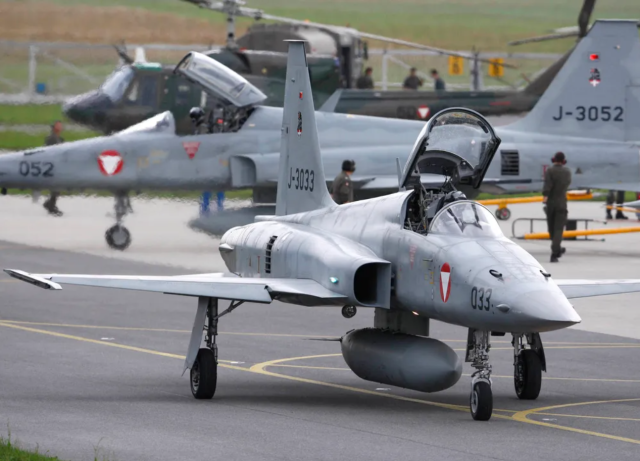
“We are preparing to withdraw the F-5 fighter jets from service before the end of next year,” Son said during a meeting with defense ministry correspondents in Seongnam, Gyeonggi Province, on Wednesday.
The F-5 has long served as one of the Republic of Korea Air Force’s key light fighter jets. Introduced in the 1970s and later produced locally as the KF-5, the aircraft helped expand South Korea’s fighter fleet at a time when the country was strengthening its independent air defense capabilities.
Son said the Air Force is also pushing to introduce low-cost unmanned assets such as LUCAS by the early 2030s, which could be deployed in large numbers during the initial stage of a war.
“We are aiming to develop AI pilots by the 2040s and further prepare for a transition to unmanned combat squadrons,” he said.
Son said the KF-21 alone would not be enough to meet future operational needs, stressing the need to speed up the development of unmanned attack aircraft and unmanned combat aircraft.
“We will complete a manned-unmanned teaming system and connect it to a sixth-generation fighter system in the 2040s and 2050s,” he said.
He added that unmanned systems are not intended to replace humans, but to enhance combat power.
“The judgment and expertise of pilots will become even more important,” Son said.
The Air Force is also stepping up efforts to build AI-based command and operational systems.
Son said the Air Force is currently operating “Air Wars,” a generative AI platform developed in-house.
“We have established the military’s first AI-based work management system,” he said. “The Air Force is also taking part in designing generative AI platforms for the defense ministry and the defense acquisition sector.”

Copyright ⓒ Aju Press All rights reserved.