The trend is drawing growing attention as Washington expands its Indo-Pacific security operations beyond the Korean Peninsula and Japan, while Southeast Asian nations continue pursuing flexible defense ties with both major powers.
According to industry sources, some U.S. Forces Korea units recently took part in multinational drills in the Philippines, an unusual move that underscored how U.S. assets stationed in South Korea could be used more flexibly for regional contingencies.

At the same time, Thailand has moved to deepen military engagement with China while maintaining its long-standing defense relationship with the United States.
China’s defense ministry said it would hold the “Assault 2026” joint exercise in Thailand this month, focusing on operations in mountainous and jungle terrain. The drills come as Thailand continues to participate in Cobra Gold, one of the region’s largest U.S.-led multinational exercises.
A report by the Asan Institute for Policy Studies said South Korea’s advanced technology, its status as a “non-threatening power,” and its relatively neutral image have made it an attractive partner for Southeast Asian countries seeking to modernize their militaries.
In that environment, South Korean weapons are emerging as a practical option for countries seeking advanced but relatively affordable systems that are not directly tied to either Washington or Beijing.
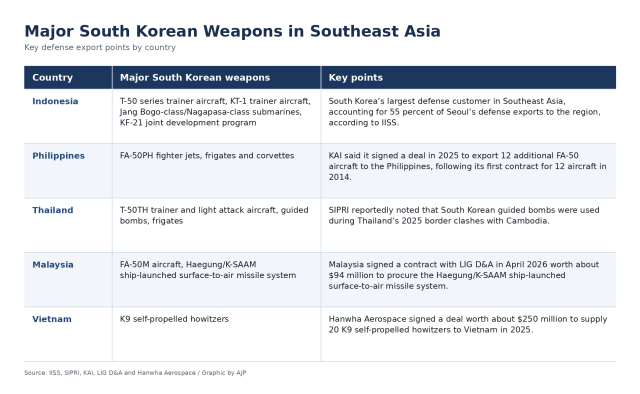
Indonesia has been South Korea’s largest customer in Southeast Asia, accounting for 55 percent of defense exports to the region over the past two decades, according to an analysis by the International Institute for Strategic Studies.
Jakarta has imported Korean-made T-50 and KT-1 trainer aircraft, as well as Jang Bogo-class submarines, while also participating in the KF-21 fighter development program. The relationship has evolved beyond simple arms purchases into broader technology cooperation and joint development.
Philippines has also emerged as one of Seoul’s key defense partners, particularly as Manila seeks to strengthen its air and maritime capabilities amid tensions in the South China Sea.
The Philippine military operates FA-50PH light attack aircraft and has moved to expand its fleet, with Korea Aerospace Industries signing a deal in 2025 to supply 12 additional FA-50 jets after its initial contract for 12 aircraft in 2014.
South Korea has also supplied frigates and corvettes to the Philippine Navy, making Korean weapons a major component of Manila’s military modernization efforts.
Thailand, while carefully balancing ties between the United States and China, has likewise adopted Korean-made defense systems.
The Royal Thai Air Force operates the T-50TH, a Thai variant of South Korea’s T-50 advanced trainer and light attack aircraft, while the country has also acquired Korean-built naval assets.
The reported use of Korean-made guided munitions during Thailand’s border clashes with Cambodia in 2025 highlighted how Korean weapons are no longer merely procurement items, but could increasingly become part of real-world regional security dynamics.
Malaysia has expanded its purchases of Korean defense systems from aircraft to naval air defense platforms.
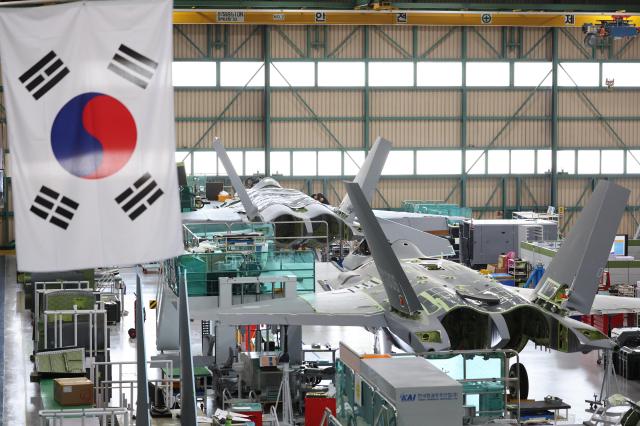
Kuala Lumpur signed a deal in 2023 to acquire 18 FA-50M light combat aircraft from Korea Aerospace Industries, strengthening South Korea’s role in Malaysia’s air force modernization program.
In April 2026, Malaysia also signed a contract worth about $94 million with LIG Defense & Aerospace to purchase the Haegung, or K-SAAM, ship-launched surface-to-air missile system, which is expected to be installed on three Malaysian Navy vessels. The agreement marked the first overseas sale of the Haegung system.
However, he also pointed to a potential challenge for Seoul as global demand for Korean weapons rises, questioning whether Southeast Asian buyers, which typically place smaller orders, could be pushed “to the back of the line.”
Vietnam has recently emerged as a new market for South Korean ground weapons, with bilateral defense cooperation reaching a symbolic turning point through the K9 deal.
In 2025, Hanwha Aerospace signed a deal worth about $250 million to supply 20 K9 self-propelled howitzers to Vietnam, marking South Korea’s first arms export to the country.
The deal is significant not only because Vietnam has long relied heavily on Russian weapons, but also because it reflects how two countries that were once adversaries during the Vietnam War are now moving toward a strategic defense partnership.
Vietnam’s purchase of the K9 is also seen as part of a broader effort to diversify defense procurement sources amid growing uncertainty surrounding Russian supply chains.
Ian Storey of Singapore’s ISEAS-Yusof Ishak Institute said South Korea has become an attractive option for Southeast Asian countries because Seoul offers advanced weapons at lower prices than Western suppliers and is more willing to transfer technology to support local defense industries.
“South Korean arms are hi-tech and cheaper than Western defense equipment,” he said.
Prashanth Parameswaran, a regional security analyst, said South Korea’s expanding security ties with ASEAN countries have created opportunities for Seoul but also pose challenges.
While deeper defense cooperation gives South Korea room to expand its role as a regional security partner, it also exposes Seoul to the political risks of becoming more directly involved in Southeast Asia’s disputes and broader great-power competition.
For Seoul, the question is whether it can remain primarily an arms supplier or whether growing demand for Korean weapons will push it toward a broader strategic role in Asia’s security order.
As more Southeast Asian countries integrate Korean systems into their military modernization programs, defense exports may become increasingly difficult to separate from diplomacy and regional security politics.

Copyright ⓒ Aju Press All rights reserved.