SEOUL, May 14 (AJP) - Restraint from joining the global gold rush may have worked in the favor of the Bank of Korea, as the country’s relatively low gold exposure helped shield South Korea from sharper foreign reserve losses during market turmoil triggered by the Iran war earlier this year.
As oil prices surged following the outbreak of the conflict in late February, governments around the world drew down reserves in March to stabilize currencies and protect their economies.
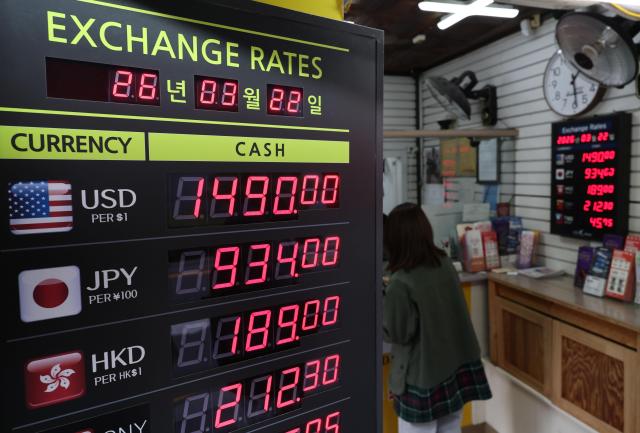
South Korea’s foreign reserves fell by $4 billion as authorities intervened to defend the won after it weakened beyond 1,490 per dollar, according to the BOK.
Despite the intervention, the decline was among the smallest recorded among major reserve-holding countries.
China’s reserves fell by $85.7 billion in March, while India’s dropped by $37.4 billion. Russia posted a $60 billion decline and Germany recorded a $69.2 billion decrease.
Among the world’s 12 largest reserve holders, only Saudi Arabia outperformed South Korea, posting a $20 billion increase as Dubai crude prices averaged more than $120 per barrel during the month.
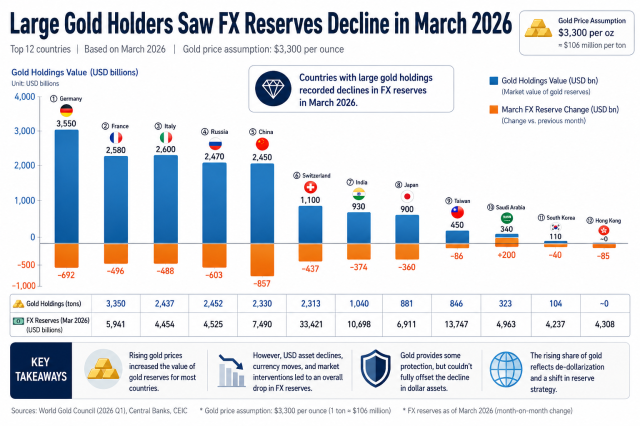
Analysts say South Korea’s comparatively low exposure to gold helped cushion reserve volatility as the precious metal — traditionally regarded as a safe-haven asset — turned unexpectedly volatile during the crisis.
Although the U.S. dollar index rose above 100 following the blockade of the Strait of Hormuz and a broader flight toward safe assets, international gold prices fell sharply in March. Prices dropped 3.3 percent to $4,867.7 per troy ounce from $5,034.4 in February.
The decline erased roughly half of February’s gains, when gold prices had climbed nearly 6 percent from the previous month.
Gold prices continued to weaken through April and May even as the dollar index remained near 98. The April average slipped below $4,800 per troy ounce, and by Thursday prices had fallen further to $4,688.
Analysts attributed the downturn partly to the scale of gold’s earlier rally. Prices, which stood near $2,700 per ounce in January last year, had surged to more than $5,100 by January this year — an increase of roughly 80 percent in just 12 months.
Expectations that U.S. interest rates had peaked also contributed to the rally.
When U.S. consumer inflation remained stable at 2.4 percent year-on-year in January, markets increasingly expected the Federal Reserve to cut rates and resume quantitative easing in line with the policy stance of President Donald Trump. The yield on the 10-year U.S. Treasury bond remained near 4.1 percent at the time.
The outbreak of war quickly altered those expectations.
Average March prices for the world’s three major oil benchmarks — West Texas Intermediate (WTI), Brent and Dubai crude — all exceeded $100 per barrel, fueling renewed inflationary pressure.
The U.S. Consumer Price Index rose 3.3 percent in March and 3.8 percent in April, while 10-year Treasury yields climbed above 4.4 percent by Thursday.
The shift prompted policymakers to adopt a more hawkish tone.
Kevin Warsh, considered a leading contender to become the next Federal Reserve chair, stressed the need to contain inflation during a late-April hearing and rejected expectations of automatic quantitative easing.
Central bank officials across Asia have echoed similar concerns.
Major Asian central bank officials including Reserve Bank of India (RBI) Governor Sanjay Malhotra and Bank of Korea (BOK) Senior Deputy Governor Ryoo Sang-dai have both indicated that additional rate hikes may need to be considered if inflationary pressure intensifies.
With gold retreating from record highs and the prospect of higher interest rates reemerging, investors have increasingly shifted funds back toward currency and bond markets.
“During wars tied directly to energy supply disruptions, gains in gold prices have historically been more limited than during broader financial crises,” a foreign exchange dealing room official said on condition of anonymity.
“Because gold prices had already surged to unprecedented levels before the Strait of Hormuz blockade, the base effect is becoming increasingly pronounced,” the official added.

Copyright ⓒ Aju Press All rights reserved.