
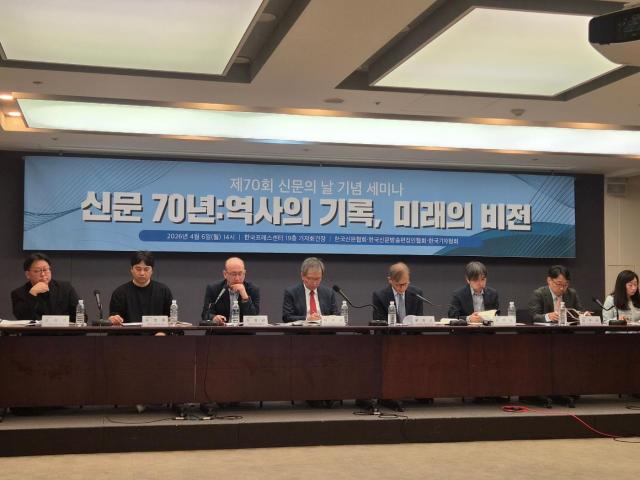
"To improve the quality of journalism, news organizations must reclaim their identity as technology companies."
Kim Wi-geun, chief research officer at Publish, made the remarks at a seminar at the Korea Press Center titled ‘70 Years of Newspapers: A Record of History, a Vision for the Future,’ saying journalism is a product of combining news and technology.
The event was organized by three media groups — the Korea Newspaper Association, the Korea Newspaper Broadcasting Editors Association and the Journalists Association of Korea — to reassess newspapers’ social role and chart a path for newspaper journalism amid rapid changes in the media environment, including the spread of generative artificial intelligence.
In a presentation titled ‘A Blueprint for Newspaper Journalism,’ Kim said technology used by news portals that dominate distribution can sharply swing a news outlet’s audience and revenue, adding that AI will now drive those shifts.
Kim repeatedly stressed that media companies are “clearly technology companies” and urged them to restore that identity. Before the internet became widespread, he said, print newspapers were leading technology firms in areas such as typesetting and printing formats, while broadcasters led in video and transmission technology.
He said news organizations lost their “technology DNA” as web technology spread, and argued that regaining it is essential to raising journalistic quality.
As a future strategy, Kim proposed establishing an identity as a “data company.” In the AI era, he said, the role of news content as digital data will grow beyond its value as a copyrighted work. He also called for efforts to boost trust, pursue technological innovation including cooperation on developing sovereign AI, strengthen gatekeeping, establish media ethics and prevent reporters from leaving newsrooms.
If reporters’ planning and questioning skills do not surpass those of the public, he said, news organizations will lose competitiveness. He predicted demand will rise for high-quality journalism that verifies facts and pursues truth.
A separate speaker urged the newspaper industry to adapt more flexibly to social change. Lee Min-gyu, a professor in Chung-Ang University’s Department of Media Communication, cited the case of 18 newspapers publishing extra editions for BTS’ Gwanghwamun comeback performance, saying newspapers need to move beyond rigid, politics-and-economy-centered hard news and pay more attention to culture and lifestyle content audiences want.
Lee also pointed to editorial cartoons, which he said compress a newspaper’s interpretive function into a single image, and argued newspapers have a role in an environment where information overload and AI hallucinations increase the risk of distortion.
He said newspapers should help lead public opinion and keep society on the right path. AI should be used as a tool, he said, but editing must remain a human task. He also urged news outlets to reduce dependence on platforms and strengthen relationships with readers.
Lee said a newspaper’s competitiveness lies not in the number of stories but in the density of trust, adding that earning trust from readers and society is more important than ever. He said the industry should jointly push for public-interest safeguards in algorithms, legal guarantees of algorithmic transparency and clear labeling standards for AI-generated news.
Examples of how news organizations are responding to the AI era were also presented. Kyunghyang Shinmun said its YouTube channel, ‘Kyunghyang TV,’ launched in January 2024, has grown quickly as political analysis and in-depth interviews gained popularity. The outlet plans to invest in a dedicated video studio to strengthen content quality and production capacity.
Yoo Young-hoon, deputy head of Maeil’s AX AI Data Department, said AI services cost more than expected and called for continued investment along with ways to generate revenue.
* This article has been translated by AI.
Copyright ⓒ Aju Press All rights reserved.