
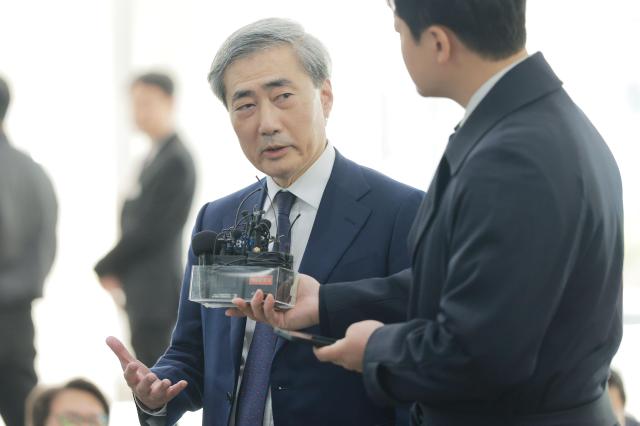
Shin Hyun-song’s nomination as the next governor of the Bank of Korea has been broadly welcomed by markets, reflecting confidence in both his credentials and temperament. In my own brief encounters with him, he left a strong impression of humility — a trait not always associated with figures of global stature.
Few would dispute that his theoretical grounding and practical experience rank among the best. Notably absent so far is the kind of envy or backlash that often trails even the most capable nominees. His long career abroad may partly explain that. Whether that global pedigree proves to be an asset or a liability, however, will soon become clear.
Because the timing leaves little room for abstraction.
South Korea’s economy is entering what can only be described as an emergency phase. The shock from U.S. and Israeli strikes on Iran has already rippled through markets. Oil prices have surged, the won has weakened past 1,500 per dollar, and the familiar but dangerous combination of rising inflation risks and slowing growth has returned. Financial stability — not just growth — is again the immediate concern.
In such moments, policy coordination becomes critical. The so-called “F4” — the finance minister, the BOK governor, the Financial Services Commission chair and the Financial Supervisory Service governor — forms the core command structure. By most assessments, the current lineup lacks cohesion and depth, particularly with the departure of Gov. Rhee Chang-yong, widely regarded as the strongest international voice in the group.
Shin’s global standing likely tipped the balance in his favor. Yet that same background raises a practical question: how quickly can he translate international expertise into domestic crisis management?
The presidential office has pointed to his prescience ahead of the 2008 global financial crisis and his role in designing key stabilization tools — including levies on foreign-exchange liabilities and forward position limits — as evidence of readiness. Still, whether those credentials translate into real-time responsiveness in today’s far more complex environment remains an open question.
His policy challenge begins with a familiar dilemma, now intensified: balancing price stability against growth.
Under Rhee, policy at times leaned toward supporting growth, including relatively aggressive rate cuts. Today, the constraint is different. The exchange rate has become the fault line. The won’s sharp decline — and the perception that it has underperformed peers under the current administration — has fueled calls for tightening. Yet the domestic economy, already weakened by external shocks, makes a rate hike difficult to justify.
Shin is often described as hawkish, but his recent remarks suggest caution. His observation that dollar liquidity remains stable — and that exchange rate movements need not immediately signal financial instability — has been read as a signal that policy may stay on hold. Some have even interpreted it as tolerance for further won weakness, raising the possibility that easing could remain on the table.
In the near term, the priority is unlikely to be rates alone.
Stabilizing the foreign-exchange market and restoring confidence may require a broader toolkit. Just as important will be Shin’s ability to assert leadership within the F4 framework. His emphasis on the economy’s capacity to absorb shocks — rather than fixating on the exchange rate level itself — points to a strategy centered on managing volatility rather than defending a specific line.
His first real test, in that sense, is simple but unforgiving: whether the market stabilizes.
Beyond the immediate horizon lies a more complex landscape. The Middle East conflict, elevated oil prices and shifting U.S. monetary policy will continue to weigh on Korea’s outlook. Even in a best-case scenario, a quick return to stable global conditions appears unlikely.
And even if external pressures ease, structural challenges remain: restoring potential growth, managing household debt, and recalibrating an economy that has grown increasingly vulnerable to external shocks.
This is where Shin’s role may need to expand.
The Bank of Korea cannot remain a rate-setting institution alone. It will be expected to function as a strategic anchor — helping to redesign economic balance in a period of overlapping crises.
At the same time, central bank independence will come under scrutiny. With the Lee Jae Myung administration holding a parliamentary majority, tensions may not surface immediately. In crisis, alignment between fiscal and monetary authorities is natural, even necessary. But over time, the familiar friction between political priorities and monetary discipline is likely to re-emerge. That, too, will be part of Shin’s test.
In just over 10 days, he is expected to take office. The pace of events suggests he will have little time to settle in. Markets will not grant a grace period.
His National Assembly confirmation hearing may, in effect, be his only window to refine his approach.
After that, the real test begins.

About the author:
▷International economics, Seoul National University College of Social Sciences and graduate school ▷Ph.D. in economics, University of Missouri ▷CEO, MaeKyung TV and MaeKyung Publishing; Washington correspondent and editorial writer, Maeil Business Newspaper ▷Visiting professor, Seoul National University Department of Economics ▷CEO, Yeonwoo Consulting
Copyright ⓒ Aju Press All rights reserved.
