
According to data compiled by financial information provider FnGuide, Samsung SDI, SK On, and LG Energy Solution are projected to post operating losses for the first three months of this year.
Samsung SDI is estimated to have posted an operating loss of 263.5 billion won ($196 million), while SK On is expected to report a loss of around 300 billion won. LG Energy Solution, in a preliminary report earlier this week, recorded an operating loss of 207.8 billion won.
These losses reflect a triple whammy for the sector, driven by slowing global EV demand, automakers' inventory adjustments, and falling raw material prices.
In particular, LG Energy Solution's operating loss would widen to around 400 billion won if the Advanced Manufacturing Production Credit (AMPC), a U.S. tax incentive under the Inflation Reduction Act, is excluded.
Samsung SDI is also believed to have seen a sharp decline in profitability, while SK On is expected to continue its streak of quarterly losses.
The slowdown is also reflected in global market data. According to SNE Research, an energy market research firm specializing in batteries, total battery usage in electric vehicles (EVs), plug-in hybrid vehicles (PHEVs), and hybrid vehicles (HEVs) reached 134.9 gigawatt-hours (GWh) during the peiod, rising just 4.4 percent from a year earlier.
The combined global market share of the three battery makers fell to 15 percent, down 2.2 percentage points year-on-year. A sharp 29.8-percent drop in U.S. EV sales led to declining battery usage across all three companies. LG Energy Solution recorded 11.8 GWh (-2.7 percent), SK On 5.2 GWh (-12.9 percent), and Samsung SDI 3.3 GWh (-21.9 percent), marking the steepest decline among major players.
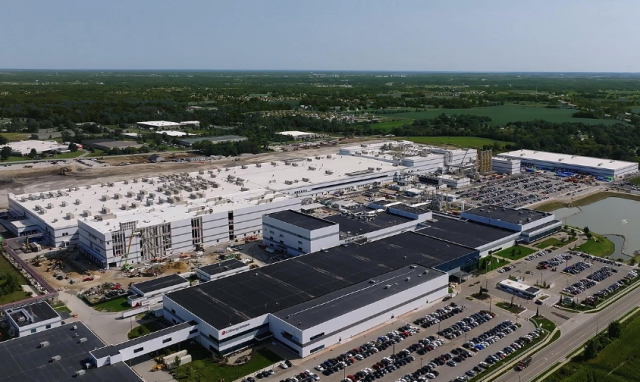
But the losses are widely seen as reflecting ongoing investment rather than a structural downturn, as the three battery makers expand their production capacity in the U.S. to secure a foothold in the North American market. With such aggressive investment in North America, a gradual recovery is expected in the second half of the year as more affordable EVs and energy storage systems (ESS) would gain traction.
LG Energy Solution is expanding its U.S. footprint including its joint venture Ultium Cells with General Motors, one of the largest U.S. automakers, and plans to begin mass production of ESS batteries in the second quarter.
Samsung SDI is also preparing ESS battery production through its joint venture with Stellantis, formed through the merger of Fiat Chrysler Automobiles and PSA Group. Earlier this year, it secured a large battery deal in the U.S. and followed it up with a 1.5 trillion won ($1.1 billion) ESS contract last month, extending its order momentum.
SK On operates a plant in Georgia and is building additional facilities through its equally held venture with Ford Motor Company to produce EV batteries in the U.S. It recently suspended operations at its first Georgia plant and shifted production to the second plant to improve efficiency. The company also signed a 2 trillion won ESS supply deal with Flatiron Energy Development, an ESS developer founded in 2021.
Such front-loaded investments are expected to lay the groundwork for a recovery in earnings, as higher utilization rates would allow U.S. subsidies under the Advanced Manufacturing Production Credit (AMPC) to be more fully reflected in results.
These front-loaded investments are expected to lay the groundwork for a recovery in earnings, as higher utilization rates would allow U.S. subsidies the AMPC.
SK On is also boosting efficiency at its operations in Hungary, supported by steady growth in the European market. Its second plant in Komárom is operating at around 80-percent utilization rates and supplies nickel-cobalt-manganese (NCM) batteries, a high-performance EV battery chemistry, to Volkswagen Group and Ford Motor Company including for models such as the ID.4 and ID.7.
Automakers are set to launch more affordable EVs in the US$20,000–$30,000 range, which could revive delayed demand and boost battery shipments. The expansion of the energy storage system (ESS) market could be another positive factor.
Surging power demand from artificial intelligence (AI) data centers is driving growth in large-scale energy storage, as battery makers expand beyond EV-focused portfolios and position ESS as a key growth engine.
Meanwhile, shares of LG Energy Solution and Samsung SDI were up 2.34 percent from the previous session as of Thursday morning.

Copyright ⓒ Aju Press All rights reserved.
