
Although instinctively oil-poor, the country has quietly built one of the most sophisticated stockpiling systems among non-producing nations. Its extensive network of underground storage and refining infrastructure has turned it into an attractive “offshore reserve base” for major Gulf exporters seeking to hedge against geopolitical choke points.
Multiple Middle Eastern oil producers have approached Seoul to explore storing their crude in Korea, home to the nine fuel storage bases including underground tanks and the world's single largest oil storage base with a combined capacity for 146 million barrels.
“Countries, particularly in the Middle East, are showing increasing interest in using Korea’s stockpiling facilities,” Yang Ki-wook, director general for industrial resource security at the Ministry of Trade, Industry and Energy, said in a press briefing Tuesday.
The interest reflects a strategic shift among exporters such as Saudi Arabia, the United Arab Emirates and Kuwait, whose economies are heavily dependent on uninterrupted oil flows through the Gulf. By pre-positioning crude outside the Strait of Hormuz, they can reduce exposure to geopolitical risks and maintain supply flexibility.
The arrangement offers both commercial and strategic gains for the country.
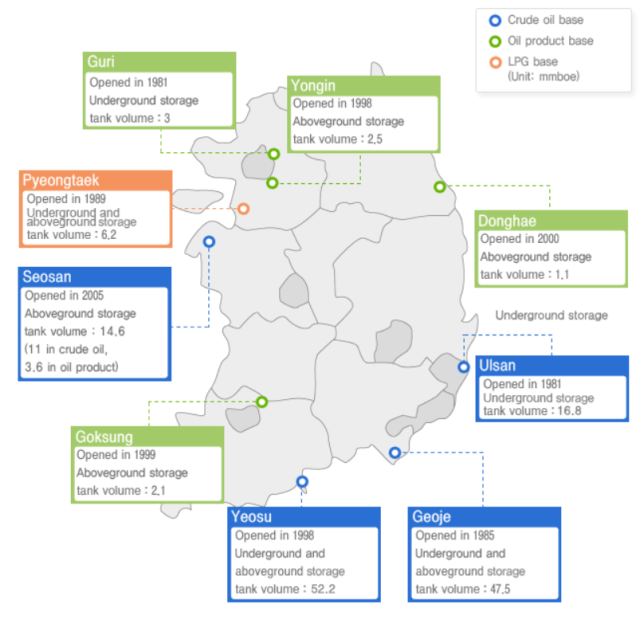
Under its international joint stockpiling program, state-run Korea National Oil Corp. (KNOC) leases idle storage capacity to foreign producers, generating rental income while securing priority rights to purchase the stored oil during supply disruptions.
Korea on March 12 joined the International Energy Agency's emergency release by contributing 22.46 million barrels of strategic oil reserves to help contain international oil prices after the U.S.-Israeli attacks on Iran. The country currently holds about 100.1 million barrels of government-controlled reserves, fifth largest among IEA members.
Korea also stores roughly 10 million barrels of foreign crude under joint agreements, including 4 million barrels for Kuwait Export Crude and 4 million barrels of light sour grades from Abu Dhabi National Oil Co.
The government is stepping up contingency measures to stabilize supply and prices while securing alternative crude supplies as the war stretches close to two months.
Seoul has secured 118 million barrels of extra crude, with 46 million barrels allocated for April and 72 million barrels for May. The volumes are sourced from 17 countries, including Saudi Arabia, the United Arab Emirates, the United States, Brazil and Australia.
“Saudi Arabia accounts for the largest share of April shipments,” Yang said, adding that stockpile swap volumes stand at around 32 million barrels.
Of the swap requests filed by four domestic refiners, 8.38 million barrels across six contracts have already been delivered, with an additional 8 million barrels expected to be contracted within the month.
The stockpiling framework has played a supporting role in these negotiations, officials said, as Korea’s ability to offer storage options strengthened its position in securing replacement cargoes.
For emergency actions at home, the government will extend a credit ceiling of up to $3 billion to the Korea National Oil Corp. (KNOC), backed jointly by the Export-Import Bank of Korea and the Korea Development Bank, to support timely crude imports.
Demand-side controls are also being introduced, including adjusting construction schedules to manage asphalt demand and monitoring market disruptions in construction additives.

Copyright ⓒ Aju Press All rights reserved.
