

The 2026 AI Index Report, released Tuesday by Stanford University's Institute for Human-Centered Artificial Intelligence, is a 423-page annual assessment widely regarded as one of the most authoritative gauges of global AI progress.
South Korea registered 14.31 AI patents per 100,000 people in 2024 — far ahead of Luxembourg at 12.25, China at 6.95 and the United States at 4.68.
Adoption is accelerating just as quickly. Generative AI usage rose from 25.9 percent in the first half of 2025 to 30.7 percent in the second half, the fastest increase among 30 regions surveyed. The gain pushed South Korea up seven places to 18th globally, though still well behind leaders such as the United Arab Emirates at 64 percent and Singapore at 60.9 percent.
On paper, policy momentum is strong. South Korea enacted 17 AI-related laws between 2016 and 2025 — the second-highest among G20 nations after the United States. The report highlighted the AI Basic Act, which took effect this year, as a cornerstone framework aimed at fostering innovation while building public trust.
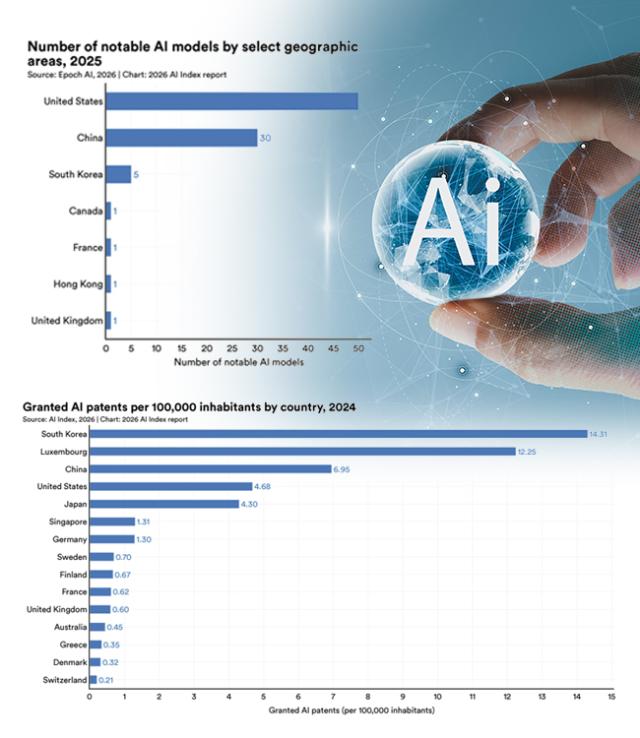
But beneath these headline gains, the gaps widen.
Private AI investment totaled just $1.78 billion, placing South Korea 12th globally — a fraction of the $285.9 billion poured into the sector in the United States and $12.4 billion in China. Even with 59 newly funded AI firms, the ecosystem lacks the scale to match its innovation output.
Structural weaknesses extend to the workforce. About 81.4 percent of South Korea's AI talent pool is male, one of the widest gender imbalances among surveyed countries, alongside Japan and Brazil.
More critically, institutional support is lagging. South Korean employees gave their organizations some of the lowest marks globally for AI readiness.
Workers in Japan, South Korea and Portugal reported the weakest support for AI literacy training and governance frameworks, with fewer than half saying their employers provide meaningful backing. In India, by contrast, roughly 85 to 90 percent reported strong institutional support.
The disconnect between individual adoption and organizational readiness is not unique to Korea, but it is particularly pronounced.
A McKinsey survey found 88 percent of organizations use AI in at least one business function, yet 60 percent say adoption remains stuck at the pilot stage — a gap increasingly described as "shadow AI," where employees deploy tools informally outside official systems.
"South Korea is known to have a particularly high rate of shadow AI usage. Even though formal adoption through corporate channels remains limited, employees are quietly using these tools on their own," said Park Hyun-kyu, professor of management of technology at Sogang University.
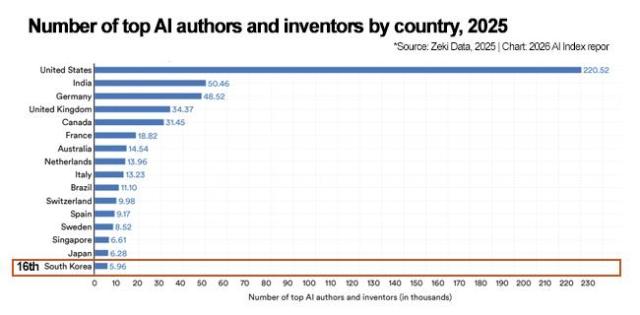
For South Korea, the picture is clear: a country moving faster than most at the edge of adoption and innovation, but held back by hesitant institutions and underpowered capital. Until that gap closes, its AI momentum risks remaining diffuse — energetic, but not yet fully mobilized.
Copyright ⓒ Aju Press All rights reserved.
