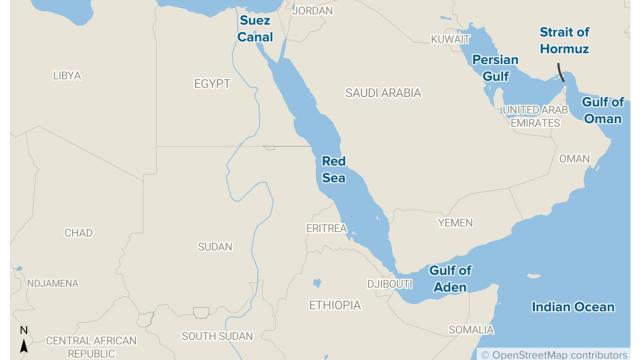
The Korean sea flag carrier makes the first confirmed shipment to reach Korean-bound routes via a Hormuz bypass since the Gulf conflict disrupted one of the world’s most critical energy corridors, according to the government.
The Ministry of Oceans and Fisheries on Friday said the vessel departed from Yanbu on Saudi Arabia’s Red Sea coast and navigated the high-risk waterway without incident amid ceasefire between the U.S. and Iran and separately between Israel and Lebanon.
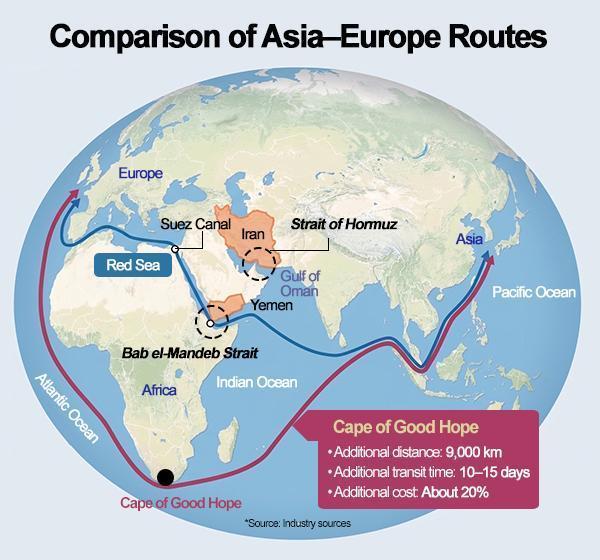
Iran has threatened to block the Red Sea trade route in retaliation to the U.S. naval blockade of the Strait of Hormuz.
According to Iranian state media, the commander of Iran’s joint military command said Iran would “act with strength to defend its national sovereignty and its interests”, warning it would completely block exports and imports across the Persian Gulf region, the Sea of Oman and the Red Sea.
The Red Sea — increasingly volatile since the 2023 Israel–Hamas war — has seen at least 79 reported vessel attacks linked to Yemen’s Iran-backed Houthi forces, making it a route long discouraged for commercial shipping. Yet with Hormuz partially shut and roughly a fifth of global oil flows disrupted, Seoul has been forced to test options once deemed too dangerous.
The ministry said it maintained 24-hour real-time monitoring of the vessel, providing navigation intelligence and running constant communication channels with the ship and operator throughout the transit.
The operation follows high-level policy coordination. At an emergency economic review meeting on April 6, the government formally discussed using the Red Sea corridor as a contingency route, pairing supply diversification with enhanced maritime safety oversight.
Some 26 South Korea-linked vessels — including crude tankers, LNG carriers and bulk ships — remain stranded or delayed around the Persian Gulf, reflecting the bottleneck created by the prolonged standoff.
For an economy that routes around 70 percent of its crude imports through Hormuz, the stakes remain acute.
Saudi Arabia accounted for 33.6 percent of Korea’s crude imports in 2025, followed by the United States (17 percent), the United Arab Emirates (11.4 percent), Iraq (10.4 percent) and Kuwait (8.5 percent), underscoring the country’s structural dependence on Middle Eastern supply lines.
“The government will continue to prioritize the safety of our vessels and crews while working with relevant agencies and industry to ensure stable crude transport from the Middle East,” Oceans Minister Hwang Jong-woo said.
Tensions have showed sign of easing with U.S. President Donald Trump saying the war was "very close to over" with the second round of talks being readied to take place over the weekend in Pakistan.
Separately, Washington is arranging the first high-level direct peace talks between Israel and Lebanon for the first time in decades.
Copyright ⓒ Aju Press All rights reserved.