
South Korea’s industrial sector is being shaken by growing labor risk, with unions stepping up pressure even as companies expand record bonuses and broaden conversions to regular employment aimed at job stability, industry officials said.
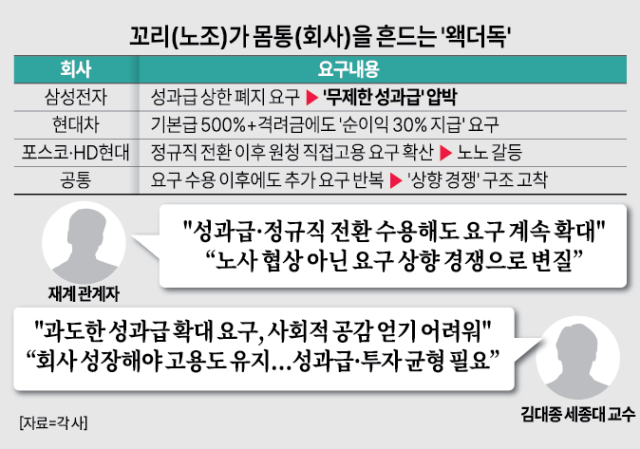
According to the industry on the 22nd, the Samsung Electronics labor union’s joint struggle headquarters plans a large rally on the 23rd with about 37,000 participants, widely seen as a show of force ahead of any strike. The union’s key demand is to abolish the cap on performance bonuses. Samsung Electronics pays bonuses based on business-unit results but sets an upper limit; the union is seeking its full removal, effectively calling for unlimited, performance-linked compensation. With the semiconductor market highly volatile, the demand could increase the company’s burden by making the pay structure less flexible on the downside.
Unions at Hyundai Motor Group are showing a similar pattern. Hyundai Motor paid about 500% of base pay in performance bonuses last year, along with encouragement payments in the tens of millions of won, marking its highest compensation level on record. Even so, the union has put a demand for a bonus equal to 30% of net profit on the wage and collective bargaining agenda. Industry watchers warn that tying bonuses to a fixed share of profit could reduce funds available for investment.
Efforts to improve conditions across prime contractors and subcontractors are also facing complications. POSCO and HD Hyundai are strengthening measures such as converting partner-company workers to regular positions and improving treatment. But at worksites, additional demands from subcontractor unions and pushback from existing regular-worker unions are mixing, with signs of union-on-union conflict. Analysts say cooperation measures are expanding into broader calls to reshape employment structures, sowing new disputes.
The trend is adding to pressure as external conditions remain uncertain, including energy-price instability tied to rising tensions in the Middle East and ongoing pressure from global supply-chain restructuring. The industry is increasingly wary that labor risk could go beyond higher costs and weaken fundamental competitiveness.
A business group official said, “Even when companies accept demands such as bigger bonuses or conversions to regular employment, a structure is taking hold in which additional demands are repeated,” adding that it is “turning into an upward competition to keep raising demands, rather than labor-management negotiations.”
Experts say repeated, short-term demands in an environment of weak trust between labor and management could undermine sustainability across industry. They also warn that if internal conflict drags on as global competition intensifies, both companies and workers could end up losing.
Kim Dae-jong, a professor of business administration at Sejong University, said, “Considering that major industries have been sustained in part through national support, it will be difficult to gain broad public sympathy for excessive expansion of performance bonuses demanded by unions in semiconductors or autos.” He added, “Because jobs can be maintained only if companies keep investing, balance between bonuses and future investment is important.”
Kim said, “Employment and wages can be maintained only if companies continue to grow,” and added that he hopes recent wage-bargaining conflicts at multiple companies will conclude in a mutually beneficial direction.
* This article has been translated by AI.
Copyright ⓒ Aju Press All rights reserved.