
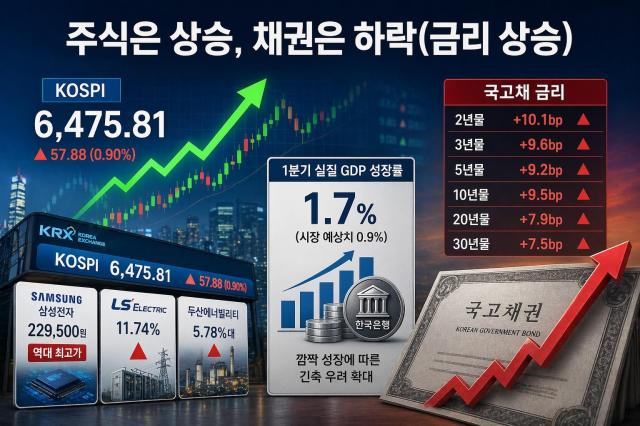
South Korea’s stock and bond markets moved in opposite directions Thursday, with the KOSPI extending its record run while government bond yields surged after a stronger-than-expected first-quarter growth report raised concerns about tighter monetary policy.
According to the Korea Exchange, the KOSPI closed up 57.88 points, or 0.90%, at 6,475.81. The index climbed as high as 6,557.76 during the session, setting an intraday record. Investor sentiment was supported after the S&P 500 and Nasdaq hit record highs overnight on an extension of a Middle East ceasefire and strong earnings from major companies.
Samsung Electronics led gains after rising to 229,500 won, an all-time high. Shares of companies seen as benefiting from strong earnings expectations also advanced, including LS ELECTRIC, up 11.74% after posting its biggest quarterly profit, and Doosan Enerbility, up about 5.78%.
Bond markets, however, were jolted by economic data released earlier in the day. At 8 a.m., the Bank of Korea reported real GDP growth of 1.7% in the first quarter, nearly double the market forecast of 0.9%. As strong growth tied to a semiconductor upcycle was confirmed, expectations for interest-rate cuts later this year faded quickly, triggering heavy selling in bonds.
Data from Koscom’s Check terminal showed yields rose across the curve. The two-year government bond yield posted the sharpest jump, up 10.1 basis points from the previous day. The three-year yield rose 9.6 basis points and the five-year yield gained 9.2 basis points, both up more than 9 basis points.
Yields on longer maturities also climbed: the 10-year rose 9.5 basis points, the 20-year gained 7.9 basis points and the 30-year added 7.5 basis points. Analysts said the larger rise in short-term yields suggests markets are revising the expected path of rate cuts and pricing in tighter conditions sooner.
Brokerages said volatility could persist as investors react to data surprises.
A securities industry official said first-quarter GDP was strong on the semiconductor upcycle, but growth could slow slightly as Middle East risks are reflected. With geopolitical uncertainty lingering, the official said market rates are likely to swing as investors watch both economic indicators and developments in the region.
* This article has been translated by AI.
Copyright ⓒ Aju Press All rights reserved.