
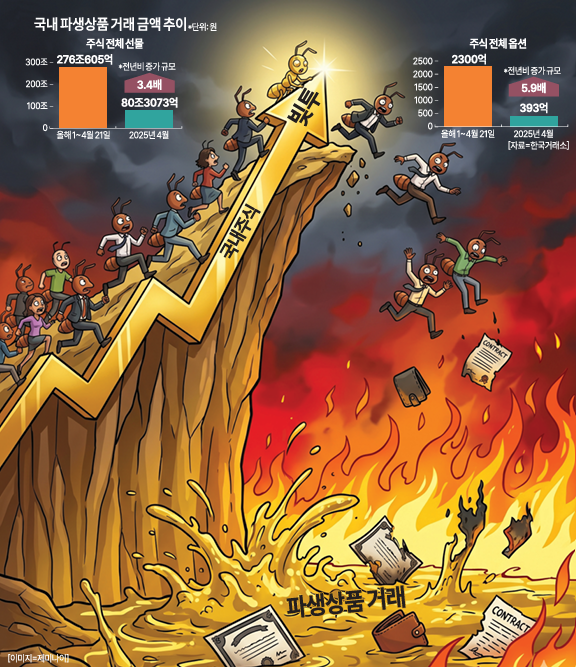
As South Korea’s stock market rally continues, retail investors are increasing high-risk leveraged bets, with trading in derivatives tied to individual stocks surging more than threefold from a year earlier. The rise in debt-funded investing has also accelerated, prompting warnings that household investor risk is approaching dangerous levels.
According to the Korea Exchange, retail investors traded 276.605 trillion won ($276,605,000,000,000) in domestic single-stock futures from January through April 21. That was about 3.44 times the 80.3073 trillion won ($80,307,300,000,000) recorded in the same period last year. Retail trading in stock options totaled 230 billion won ($230,000,000,000), up 5.85 times from 39.3 billion won ($39,300,000,000) a year earlier. Derivatives linked to individual stocks are generally considered riskier than index-based products because they tend to be more volatile.
The jump reflects both expectations for further gains and increased volatility, analysts said. Derivatives allow investors to bet on either rising or falling prices and can be used for hedging, but they also attract money seeking profits when price swings widen. With relatively small margin requirements, investors can take large positions. Margin rates vary, but current conditions allow leverage of roughly three to 10 times, a range that can expand or shrink with market conditions.
The concern is that heavier use of leverage can amplify losses. With 10-times leverage in futures, a 10% drop in the underlying asset can wipe out the entire investment. Options positions can also generate rapidly growing losses if the trade moves the wrong way, and some structures can produce losses exceeding the initial principal.
Leverage is also rising through margin borrowing. The Korea Financial Investment Association said outstanding margin loans stood at about 34.4694 trillion won ($34,469,400,000,000) as of April 21, repeatedly setting record highs as more individuals borrow to invest amid the market’s climb.
Such debt-backed investing can support prices in a rising market, but it can deepen shocks when sentiment turns. If share prices fall, collateral values drop, and positions can be forced into liquidation, including broker-initiated sell-offs, potentially accelerating declines. Retail investors, the report said, posted losses every year over the five-year period from 2020 to 2024.
Experts urged individuals to focus less on short-term gains and better understand the risks embedded in leveraged products. “If leveraged investing surges during a period of rising volatility, losses can spread quickly even from a small shock,” a financial investment industry official said. “In a rising market, repeated profit-taking can make it easy to underestimate risk. When the market’s direction changes, losses can expand sharply, so investors should be cautious about excessive leverage.”
* This article has been translated by AI.
Copyright ⓒ Aju Press All rights reserved.