
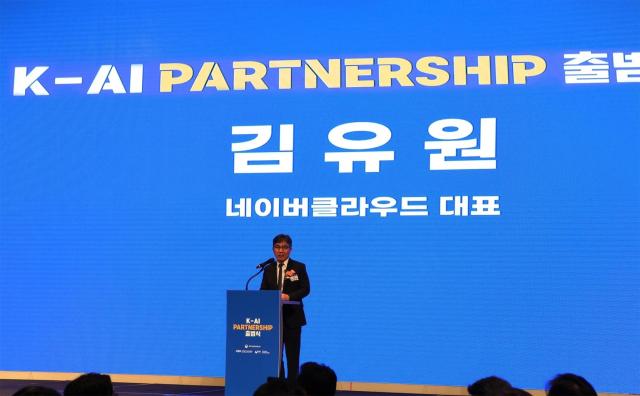
Kim You-won, CEO of Naver Cloud, has been appointed co-chair of the government-led K-AI Partnership, taking a leading role in building South Korea’s AI cooperation ecosystem and supporting global expansion.
Naver Cloud said Tuesday it was selected as a co-chair organization of the K-AI Partnership alongside the Korea Association of AI and Software Industry (KOSA).
Launched under the leadership of the Ministry of Science and ICT, the K-AI Partnership is described as the country’s first integrated public-private cooperation body bringing together industry, academia and research. It was formed to pool national capabilities for AI transformation and to support joint overseas expansion by large companies and small and midsize firms amid intensifying global competition in AI.
Unlike groups focused mainly on academic exchange, it aims for an execution-driven structure that moves from identifying on-the-ground industry demand to business matching and generating export results.
Cho Joon-hee, KOSA chairman, and Kim will serve as co-chairs. The partnership is designed to combine association leadership with private-sector participation, covering the broader industry while operating on practical technological competitiveness, the company said.
Naver Cloud said it has demonstrated its capabilities through major national AI projects and has worked as a bridge between the public and private sectors while pursuing shared growth with small businesses and startups.
Based on that experience, the company said it will support the partnership’s business model design and technical cooperation. It also plans to help strengthen AI competitiveness by combining large companies’ infrastructure with startups’ innovative technologies, and to serve as a field-focused channel for policy improvements by reflecting participating companies’ views.
“AI is a field that is difficult to complete with the capabilities of individual companies alone, and the scale of cooperation directly translates into competitiveness,” Kim said. “A true AI ecosystem will be built when the infrastructure and technological strength of large companies, the execution power of small businesses and startups, and the research capabilities of industry, academia and research institutes come together.”
* This article has been translated by AI.
Copyright ⓒ Aju Press All rights reserved.