No One Is Selling: Leverage Surges as South Korea’s KOSPI Rallies
by Seo Hye SeungPosted : May 2, 2026, 08:18Updated : May 2, 2026, 08:18
"Sell in May and go away."
It is one of Wall Street’s oldest sayings, built on the idea that returns tend to lag from May through October. The phrase traces back to 19th-century London, when aristocrats left the market during the social season.
In South Korea’s market in 2026, the saying lands differently: There is no one eager to leave, because many investors believe prices will keep rising.
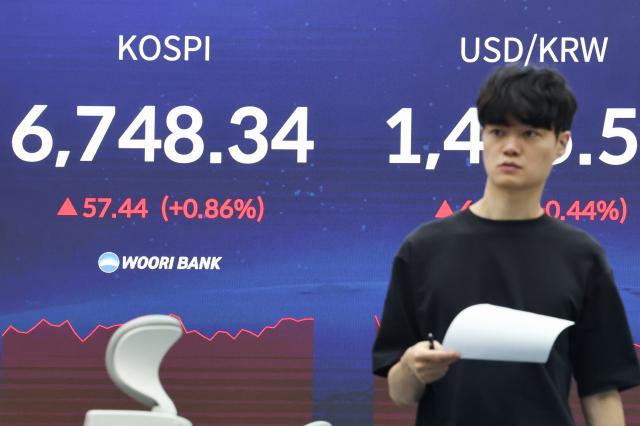
The KOSPI surged 30.61% in April, quickly recouping losses from an earlier drop tied to the war involving the United States and Israel and Iran. It pushed past 6,700 intraday to set a new record. Combined operating profit at Samsung Electronics and SK hynix topped 95 trillion won, and expectations of an AI semiconductor “supercycle” have helped lift the broader market.
The issue is not the rise itself, but the speed.
Stocks are climbing while the won and bonds are unsettled. The won-dollar exchange rate has remained highly volatile around 1,480 won. Government bond yields are rising again. Gasoline prices in Seoul have topped 2,000 won per liter, and the consumer sentiment index has slipped below 100 for the first time in a year. Manufacturing output growth slowed sharply, to 0.3% from 5.3%, nearly stalling.
As the real economy cools and equities race ahead, the gap leaves the market on weaker footing.
Leverage stands out. Outstanding margin loans in the domestic stock market hit a record 35.6895 trillion won, rising for 13 straight trading sessions. About 2.7 trillion won was added in April alone. Retail investors are not just buying shares; they are borrowing to chase the rally. NH Investment & Securities, KB Securities and Korea Investment & Securities have moved to restrict credit, a sign that market heat is outpacing brokerages’ risk controls.
The combined market capitalization of the KOSPI and KOSDAQ has climbed to about twice South Korea’s gross domestic product. The so-called Buffett indicator is nearing 200. Warren Buffett has called the measure “the best single measure of where valuations stand.” Some note that U.S. stocks have also sustained a high Buffett indicator since the era of ultra-low rates.
Still, the key point is less the level than how quickly the market got there.
Only weeks ago, the Korean market was rattled by fears tied to war, oil prices, the exchange rate and slowing growth. Now even the war is being treated as a positive. Investors have grown comfortable with the idea that “a market that rises on bad news is strong.” As prices keep climbing, confidence hardens — and that confidence can invite more borrowing. Bubbles often begin with psychology, not numbers.
The “sell in May” strategy is not a rule. Over the past 33 years, U.S. stocks rose 25 times during the May-to-October period, and Deutsche Bank has dismissed the approach as a “coin toss.” This rally also has an earnings foundation: Profit growth at Samsung Electronics and SK hynix is real, and the AI-driven expansion in power and memory demand looks closer to a structural shift. Even so, markets often get excited before fundamentals fully catch up.
Financial markets repeatedly overheat in familiar ways: belief that “this time is different,” debt starting to look normal, and rising prices dulling a sense of risk. Economist Hyman Minsky described the dynamic as “stability breeds instability,” arguing that long periods of calm encourage greater risk-taking until a small shock can topple an overleveraged system.
That does not mean South Korea’s market is on the verge of collapse. A further rally toward 7,000 on the KOSPI remains possible. The concern is the pace, not the direction. Markets rarely climb in neat steps; more often they sprint on enthusiasm and then, without warning, regain caution.
What is needed now is neither fear-driven selling nor the belief that the AI era guarantees endless gains. It is a willingness to question the speed.
A KOSPI display board is seen in the dealing room at Woori Bank headquarters in Seoul on April 30. The KOSPI opened at 6,739.39, up 48.49 points (0.72%) from the previous session, and rose as high as the 6,750 level intraday to set a session record. 2026. 4.30 (Yonhap)