
Labor disputes erupting at Samsung Electronics, the world’s fourth-largest information technology company, and Samsung Biologics, the world’s largest contract development and manufacturing organization (CDMO) for biopharmaceuticals, are more than routine wage talks. They underscore structural tensions inside the Samsung group as it enters the early stage of the artificial intelligence era. While Samsung is viewed externally as a top-tier global company, internal interests and workplace order are increasingly diverging across divisions.
Samsung Electronics posted a record first-quarter revenue of more than 57 trillion won, but profits are effectively concentrated in semiconductors. The Device Solutions (DS) division has led companywide results on the back of a boom in high-bandwidth memory (HBM) for AI data centers. By contrast, the Device eXperience (DX) division, which covers smartphones, TVs and home appliances, faces growing concerns about weakening profitability. The result is an uneven structure in which one side is booming while another is described as being at risk.
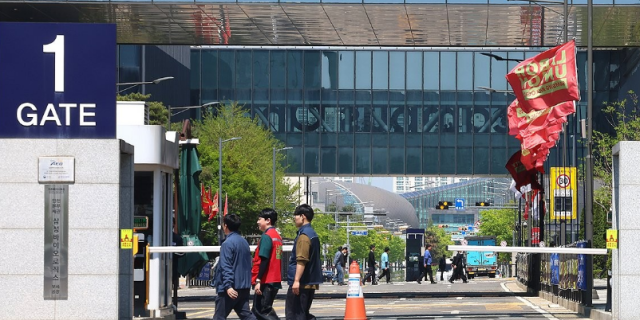
That gap is spilling into internal labor tensions. A semiconductor-focused union has warned of a general strike, demanding the removal of caps on performance bonuses and compensation tied to operating profit. Employees in non-semiconductor units have also voiced rising frustration over perceived disparities, a sign that a shared sense of belonging is being tested by widening differences in how performance is rewarded.
At Samsung Biologics, the situation is also serious. The company, which has the world’s largest production capacity, has entered its first strike since its founding. Because biopharmaceutical manufacturing is a continuous process involving living cells, any disruption can quickly translate into major losses. Global drugmakers place high value on stable supply, making internal conflict a direct risk to competitiveness in the sector.
The article notes that demands for fair compensation are not, in themselves, the issue. The AI semiconductor boom would not be possible without engineers and production workers, and skilled labor on biomanufacturing lines is also a core competitive asset. Rewarding performance is a basic principle of a market economy.
The deeper question, however, is less about “how much more” and more about “how to sustain Samsung as a single organization.” Samsung Electronics grew on an integrated model linking semiconductors, smartphones, appliances and components. During memory downturns, device businesses served as a buffer; now semiconductors are supporting the broader company. It was a structure built on enduring each other’s cycles.
Now, as division-level interests become more fragmented, a “what we earn is ours” mindset is spreading. The article argues this is not unique to Samsung but a broader challenge for manufacturers in the AI era. Maintaining a wide lead cannot be achieved by one division alone; semiconductors and data, platforms and finished products, and biomanufacturing and supply chains must move together. Integrating an organization can be harder than advancing technology.
The article points to global IT companies reshaping organizations during AI transitions, saying Microsoft has tightened links between its cloud and AI teams, and Nvidia has moved beyond being only a chipmaker toward becoming an AI ecosystem company.
What is needed, it says, is not only bigger investment or slogans about technological dominance, but a management structure and organizational philosophy suited to the AI era. Strong semiconductor earnings do not mean Samsung can become a semiconductor-only company, and having the world’s largest bioproduction capacity does not automatically secure internal trust.
Samsung, the article concludes, is at a crossroads. If it cannot integrate internal fractures despite having world-class manufacturing capabilities, today’s boom could plant the seeds of a future crisis. It calls for more precise profit-sharing, clearer solidarity across divisions, and labor-management relations that shift from confrontation to jointly designing long-term competitiveness. The real test, it argues, is beginning inside the company.
Samsung Electronics posted a record first-quarter revenue of more than 57 trillion won, but profits are effectively concentrated in semiconductors. The Device Solutions (DS) division has led companywide results on the back of a boom in high-bandwidth memory (HBM) for AI data centers. By contrast, the Device eXperience (DX) division, which covers smartphones, TVs and home appliances, faces growing concerns about weakening profitability. The result is an uneven structure in which one side is booming while another is described as being at risk.
That gap is spilling into internal labor tensions. A semiconductor-focused union has warned of a general strike, demanding the removal of caps on performance bonuses and compensation tied to operating profit. Employees in non-semiconductor units have also voiced rising frustration over perceived disparities, a sign that a shared sense of belonging is being tested by widening differences in how performance is rewarded.
At Samsung Biologics, the situation is also serious. The company, which has the world’s largest production capacity, has entered its first strike since its founding. Because biopharmaceutical manufacturing is a continuous process involving living cells, any disruption can quickly translate into major losses. Global drugmakers place high value on stable supply, making internal conflict a direct risk to competitiveness in the sector.
The article notes that demands for fair compensation are not, in themselves, the issue. The AI semiconductor boom would not be possible without engineers and production workers, and skilled labor on biomanufacturing lines is also a core competitive asset. Rewarding performance is a basic principle of a market economy.
The deeper question, however, is less about “how much more” and more about “how to sustain Samsung as a single organization.” Samsung Electronics grew on an integrated model linking semiconductors, smartphones, appliances and components. During memory downturns, device businesses served as a buffer; now semiconductors are supporting the broader company. It was a structure built on enduring each other’s cycles.
Now, as division-level interests become more fragmented, a “what we earn is ours” mindset is spreading. The article argues this is not unique to Samsung but a broader challenge for manufacturers in the AI era. Maintaining a wide lead cannot be achieved by one division alone; semiconductors and data, platforms and finished products, and biomanufacturing and supply chains must move together. Integrating an organization can be harder than advancing technology.
The article points to global IT companies reshaping organizations during AI transitions, saying Microsoft has tightened links between its cloud and AI teams, and Nvidia has moved beyond being only a chipmaker toward becoming an AI ecosystem company.
What is needed, it says, is not only bigger investment or slogans about technological dominance, but a management structure and organizational philosophy suited to the AI era. Strong semiconductor earnings do not mean Samsung can become a semiconductor-only company, and having the world’s largest bioproduction capacity does not automatically secure internal trust.
Samsung, the article concludes, is at a crossroads. If it cannot integrate internal fractures despite having world-class manufacturing capabilities, today’s boom could plant the seeds of a future crisis. It calls for more precise profit-sharing, clearer solidarity across divisions, and labor-management relations that shift from confrontation to jointly designing long-term competitiveness. The real test, it argues, is beginning inside the company.
* This article has been translated by AI.
Copyright ⓒ Aju Press All rights reserved.