
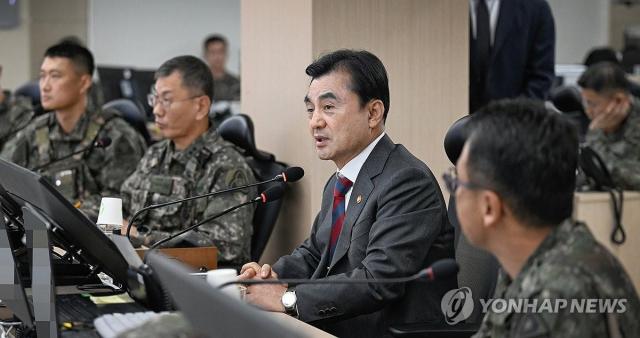
Defense Minister An Kyung-baek's visit to the United States carries significant implications. It comes at a time when sensitive issues between South Korea and the U.S., such as the transfer of wartime operational control, cooperation on nuclear-powered submarines, contributions in the Strait of Hormuz, and sharing intelligence on North Korea, are converging. While it appears to be a routine consultation, it is more of a test for managing cracks in the alliance and realigning its direction.
Recently, subtle differences in perception have accumulated between South Korea and the U.S. A prime example is the differing views on the timeline for the transfer of wartime operational control. South Korea is considering 2028 as a target, while U.S. military officials have mentioned a later timeframe, reflecting a cautious stance. This is not merely a scheduling issue; it directly relates to the leadership of the defense system on the Korean Peninsula. Wartime operational control is not just a symbol but a matter of actual military operational authority.
The fundamental principle regarding this issue must be clear. The transfer of wartime operational control should ultimately enhance South Korea's autonomous defense capabilities. However, the timing and pace should be assessed based on military readiness and the trust between allies, rather than political declarations. Rushing the schedule without meeting necessary conditions could increase security uncertainties. Conversely, delaying the transfer despite adequate preparations would signal inefficiencies in the alliance structure.
The issue of nuclear-powered submarines should also be approached in this context. This is not merely about enhancing military capabilities; it is linked to the expansion of maritime strategy. Given North Korea's advancements in submarine capabilities and the military tensions in surrounding waters, strengthening underwater deterrence is an unavoidable task. However, nuclear-powered submarines involve complex international regulations concerning technology transfer, nuclear fuel, and non-proliferation. This complexity is also why discussions between South Korea and the U.S. have been delayed. This matter should be resolved within the balance of long-term strategy and international norms rather than seeking short-term results.
The issue of contributions in the Strait of Hormuz presents another layer of challenge. The U.S. request for South Korea's contributions is rooted in a broader trend of expanding roles within the alliance. For South Korea, which heavily relies on energy imports, ensuring the stability of maritime routes is crucial. However, involvement in the Middle East comes with diplomatic burdens and military risks. Decisions regarding participation and methods should be made based on a balance of national interests and risks, rather than merely responding to alliance demands.
Sharing intelligence on North Korea is also a test of trust within the alliance. Information is a core asset in modern security. Limited sharing can inevitably reduce operational efficiency. On the other hand, unconditional sharing can lead to issues directly related to sovereignty. Ultimately, the key lies in restoring mutual trust regarding the scope and level of information sharing. Honest discussions on these issues are necessary during this visit to the U.S.
Another significant aspect of Minister An's visit is the emphasis on 'direct communication.' Alliances are not maintained through documents alone. While agreements and joint statements between leaders are important, it is the ongoing dialogue among high-level officials that truly operationalizes the alliance. In situations where various issues arise simultaneously, misunderstandings can easily accumulate. To resolve these, it is essential to meet directly to clarify positions and coordinate.
The expression by Foreign Minister Park Jin that "alliances are like gardens" warrants reflection. A garden can quickly become unruly if neglected. Weeds grow, and balance is disrupted. Conversely, consistent management allows for harmony among diverse elements. The ROK-U.S. alliance is no different. It is not a structure that maintains itself over time; it requires ongoing management and adjustment.
This visit to the U.S. is part of that management process. The important thing is to avoid fixating on short-term results. It is unrealistic to resolve all issues in a single meeting. Instead, it is more crucial to clarify differences in positions on each issue and establish a framework for future consultations. Alliances operate on a structure of continuous discussions rather than one-time agreements.
Moreover, security cooperation is not limited to the military domain. It is deeply connected to strategic industries such as energy, semiconductors, and AI. The economic and technological cooperation emphasized by Minister Park is not merely an industrial policy; it is an extension of security. The structure of cooperation between South Korea and the U.S. becomes more complex, encompassing issues like data center expansion, power demand, and nuclear fuel supply.
In this regard, this visit could serve as an opportunity to assess the transition from a military alliance to a comprehensive strategic alliance. Discussions are needed on how to design a new alliance structure that integrates security, economy, and technology. This is not just about broadening the scope of cooperation between the two countries; it directly relates to how South Korea secures its strategic space.
Ultimately, the core issue is balance. A balance must be found between autonomy and alliance, speed and caution, participation and distancing. Leaning too far in one direction can undermine the sustainability of policies. Even in the process of strengthening the alliance, our criteria for judgment and national interests must be clearly maintained.
Minister An Kyung-baek's visit to the U.S. is an opportunity to assess this balance. Alliances require more management when they are under strain. The emergence of conflicts also presents an opportunity for adjustment. The important thing is not to cover up problems but to reveal and coordinate them.
The ROK-U.S. alliance remains a central pillar of South Korea's security. However, its form and content must be adjusted to meet the changing times. It is hoped that this visit will go beyond a mere ceremonial occasion and serve as a turning point in redefining the alliance's direction in the evolving security environment.
* This article has been translated by AI.
Copyright ⓒ Aju Press All rights reserved.