
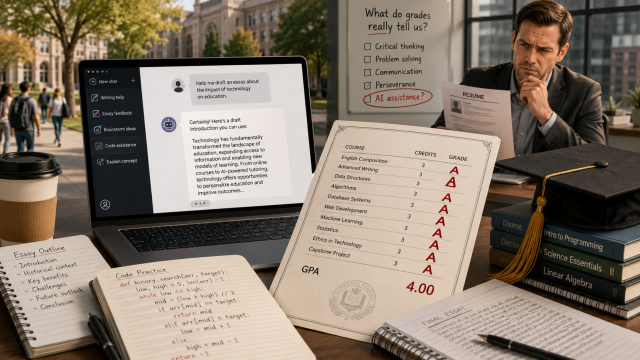
A study has found that the introduction of OpenAI's ChatGPT has led to a rapid increase in A grades at U.S. colleges, particularly in courses with heavy writing and coding assignments. The influence of generative artificial intelligence (AI) on assignment evaluations is raising concerns about the reliability of grades as a hiring criterion for companies.
According to a report by The Wall Street Journal on May 13, Igor Chirikov, a senior researcher at the University of California, Berkeley's Center for Studies in Higher Education, stated in a recently published paper that the proportion of A grades in college courses with high potential for AI use has significantly increased since the release of ChatGPT.
Chirikov analyzed over 500,000 grades from a large public university in Texas between 2018 and 2025. The university's transparency in sharing syllabi and grade distributions allowed for a comparison of assignment types and grade changes across courses.
The analysis revealed a notable increase in A grades in courses with substantial writing and coding assignments, particularly in the humanities and engineering fields. Until 2022, there was little difference between courses with high and low exposure to AI, but following the launch of ChatGPT, A grades in AI-exposed courses rose more rapidly.
In courses with high AI exposure, the number of A grades awarded by professors increased by approximately 30%. Conversely, the proportion of A- and B+ grades declined. Courses with a higher percentage of homework assignments completed at home also saw a greater likelihood of students receiving A grades.
Chirikov expressed skepticism about interpreting this trend as an improvement in student learning outcomes. He suggested that students may be leveraging generative AI to enhance their assignment results. "Learning requires a process of solving problems independently, and AI can weaken this process," he noted.
The implications extend to corporate hiring practices. As the job market for new graduates cools, companies are tightening their criteria for filtering applicants. According to the National Association of Colleges and Employers, the percentage of companies using GPA as a hiring criterion increased from 37% in 2023 to 42% recently. Global investment banks like Barclays and Morgan Stanley have set minimum GPA requirements for certain internship positions.
However, the proliferation of AI is clouding the significance of GPA. Just as AI has diminished the reliability of evaluations for cover letters and resumes, there are growing concerns that grades may reflect a student's access to and ability to use AI rather than their actual capabilities.
Some prestigious universities are beginning to address the issue of relaxed grading standards. Harvard University is discussing a cap on the percentage of A grades awarded, while Yale University noted in a report last month that "grades are meant to convey what a student has learned, but currently, they are not fulfilling that function effectively."
In response to these challenges, some universities are moving to change their evaluation methods. Chelsea Shine, a professor teaching negotiation and business ethics at the Wharton School of the University of Pennsylvania, confirmed that after recognizing the ease with which students could achieve perfect scores on assignments using AI, she has reduced the weight of homework and increased the emphasis on midterms and in-class quizzes.
* This article has been translated by AI.
Copyright ⓒ Aju Press All rights reserved.