
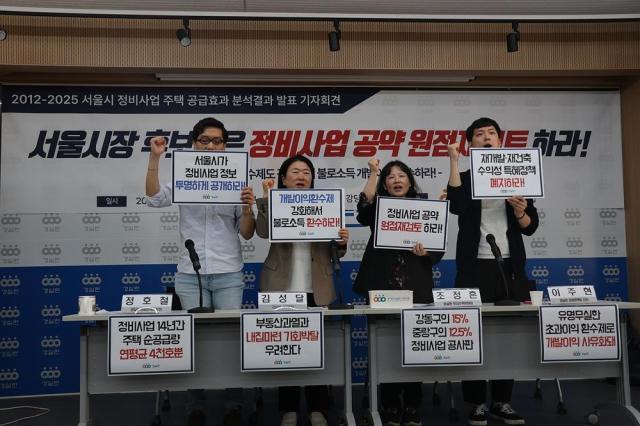
As candidates for the upcoming June 3 local elections propose promises to enhance housing supply through urban renewal projects, a recent investigation reveals that net supply has been minimal over the past decade. The analysis also confirms a significant increase in housing prices following these projects, prompting calls for a reevaluation of related campaign promises.
The Citizens' Coalition for Economic Justice reported that from 2012 to 2025, during the terms of Mayors Park Won-soon and Oh Se-hoon, the net supply of housing units from urban renewal projects in Seoul totaled only 53,000, averaging just 4,000 units per year.
During this period, an average of 20 project approvals and 21 management approvals were granted annually. While approximately 310,000 new housing units were constructed through urban renewal, the net supply, excluding demolished units, remained at 53,000 over 14 years, representing only 17% of the total units built.
An analysis of major apartment sales revealed that properties with similar market values before reconstruction have seen significant price disparities based on whether they were redeveloped, exacerbating wealth inequality.
For instance, the Sangye-jugong 8 Complex in Nowon District was redeveloped and completed as Foreena Nowon in 2020, while the nearby Sangye-jugong 9 Complex is currently undergoing planning. Previously, the price difference between these similarly sized properties was less than 100 million won, but it has now widened to approximately 300 million won. Similarly, the price gap for the Nokwon Hanshin Apartment and Dong-A Apartment in Seocho District has increased from 100-200 million won to around 2.2 billion won.
The total area designated for urban renewal, including redevelopment, reconstruction, small-scale redevelopment, and self-managed housing projects, accounts for 6% of Seoul's total area (excluding green spaces). Among districts, Gangdong occupies the largest share at 14.7%, followed by Jungnang at 12.5% and Eunpyeong at 10%.
In relation to urban renewal, Democratic Party candidate Jeong Won-o announced a real estate policy called 'Steady Development.' Meanwhile, People Power Party candidate Oh Se-hoon pledged to initiate construction on 310,000 units through urban renewal.
In response, the Citizens' Coalition urged these candidates to reassess their urban renewal promises from scratch.
The coalition stated, "Considering the negative impacts of urban renewal, if the city proceeds with initiatives like rapid integrated planning and steady development, it could adversely affect not only the lives of residents but also the real estate market on a macro level."
They added, "In the current situation where the development profit recovery system is not functioning properly, the profits from urban renewal will be privatized, further deepening wealth inequality. Strengthening the recovery of excess profits from reconstruction and recovering 50% of unearned development profits are necessary measures for the development profit recovery system."
* This article has been translated by AI.
Copyright ⓒ Aju Press All rights reserved.