
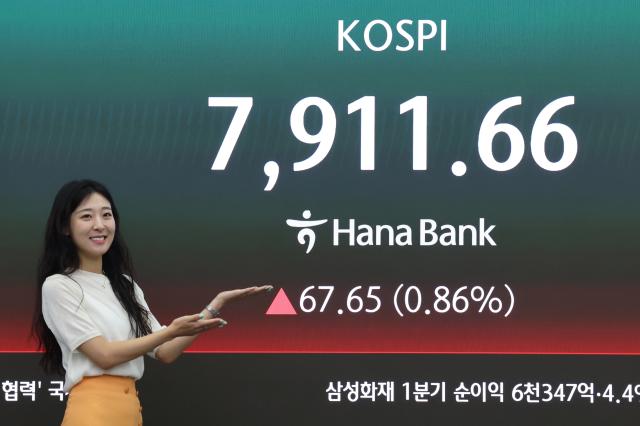
The KOSPI index is just 19 points shy of reaching the 8000 mark. It peaked at 7999.67 during trading, but closed at 7981, reflecting strong expectations for a breakthrough. This closing figure marks a record high for the index. Retail investors have been the primary drivers of this increase, showing a preference for direct investments in the KOSPI spot market over exchange-traded funds (ETFs) amid a rally that has seen recent record highs.
According to the Korea Exchange, the KOSPI finished trading on May 14 at 7981.41, up 137.40 points from the previous day, setting a new all-time closing high. Retail and institutional investors made net purchases of 18.378 trillion won and 1.898 trillion won, respectively, while foreign investors sold off 21.445 trillion won.
Retail investors have been particularly active in the recent rally. From May 4 to May 13, they recorded a total trading volume of 157 trillion won in the KOSPI market. Initially, there was a trend of net selling due to profit-taking and a wait-and-see attitude at the beginning of the month, but buying momentum quickly picked up. Retail investors sold off 4.79 trillion won on May 4 and 570 billion won on May 6, but reversed course starting May 7 with net purchases of 5.99 trillion won, followed by 3.97 trillion won on May 8 and 2.86 trillion won on May 11.
Notably, on May 12, retail investors made net purchases of 6.68 trillion won, the largest amount during this period. This buying trend continued with net purchases of 1.88 trillion won on May 13 and 1.8378 trillion won on May 14.
In contrast, the inflow of funds into KOSPI 200 ETFs during the same period was relatively limited. The KODEX 200 ETF recorded trading volume of 4.19 trillion won, while the TIGER 200 ETF saw only 625.1 billion won. The flow of funds into ETFs did not show a clear direction; KODEX 200 experienced fluctuations between net buying and selling, while TIGER 200 saw some inflow followed by outflows. KODEX 200 shifted from -1.238 trillion won to +1.459 trillion won in net purchases before returning to -286 billion won, while TIGER 200 moved from -302 billion won to +348 billion won and then back to -62 billion won.
Market analysts suggest that as expectations for KOSPI growth rise, there is a stronger preference for direct stock purchases over diversified investments through ETFs. The recent upward trend in the stock market has been largely driven by large-cap stocks, leading to expectations that spot investments may yield higher returns than ETFs.
* This article has been translated by AI.
Copyright ⓒ Aju Press All rights reserved.