
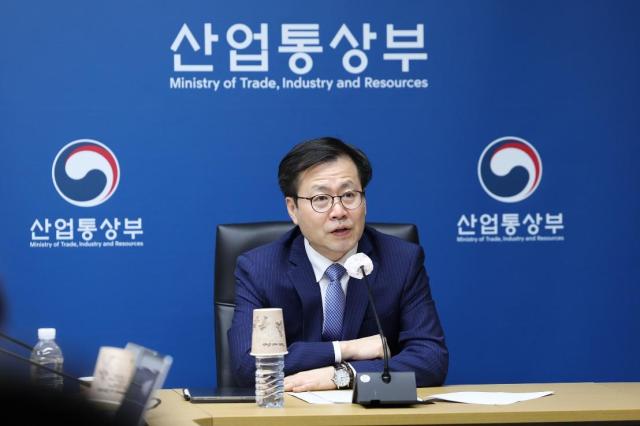
On May 14, the ministry announced that Yeo met with Valdis Dombrovskis, the European Commissioner for Trade and Economic Security, in Brussels on May 11 to discuss the EU's plans to strengthen steel import regulations and to convey the concerns of the Korean industry while seeking cooperation.
This meeting was held as the EU is set to implement the 'Steel Oversupply Response Act' starting in July, which includes raising tariffs on 30 steel products and introducing import quotas (TRQ). Yeo requested a cautious approach from the EU to ensure that Korean steel products are not subjected to unreasonable restrictions due to the new regulations.
He emphasized that the EU is Korea's second-largest steel export market and explained that these measures could impact not only the steel industry but also the supply chains and production stability of Korean companies manufacturing automobiles and electronics locally.
In response, the EU acknowledged the strategic importance of the steel industry for both Korea and the EU and expressed a willingness to seek mutually beneficial solutions through high-level and technical discussions.
Earlier, on May 10, Yeo held a meeting with Korean companies operating in the EU to assess the challenges faced by the steel, automotive, and battery sectors. Attending companies reported that various industrial and environmental regulations, including the Industrial Acceleration Act (IAA) and the Carbon Border Adjustment Mechanism (CBAM), have increased their operational burdens. They specifically expressed concerns that the upcoming steel import regulations could extend the burden to downstream industries such as automotive and electronics.
Korean battery companies operating in Poland evaluated the EU Commission's decision last December to include the battery industry as a target for support under 'energy-intensive industries' as a positive step, expecting relief from electricity costs and reduced manufacturing expenses. The ministry explained that it has continuously raised the need for support for the battery industry in discussions with the EU and Polish governments.
Yeo also visited Mexico from May 12 to 13, where he met with key figures, including Economy Minister Marcelo Ebrard, to emphasize the need for progress on the Korea-Mexico Free Trade Agreement (FTA).
He explained that Korean companies operating in Mexico are facing difficulties due to tariff increases on countries without an FTA with Mexico and requested stable implementation of tariff reduction systems, expansion of duty-free quotas for automobiles, and the introduction of new quotas for electronics.
Additionally, he conveyed the requirements of Korean companies regarding origin standards during the review process of the United States-Mexico-Canada Agreement (USMCA).
Both countries agreed on the necessity of improving trade and investment relations and decided to establish ministerial-level strategic dialogues and working groups. Yeo met with local political and business leaders to explain the importance of Korean investment in Mexico and sought cooperation for advancing the FTA.
Korean companies operating in Mexico highlighted the need for the Korea-Mexico FTA, citing increased operational burdens due to U.S. Section 232 tariffs, Mexico's tariff hikes, and strengthened labor laws.
Yeo stated, "In an uncertain trade environment, the government is actively pursuing a diversification policy. We will support our companies through expanded tariff reduction incentives and FTA progress with Mexico, our top trading partner in Latin America."
* This article has been translated by AI.
Copyright ⓒ Aju Press All rights reserved.