
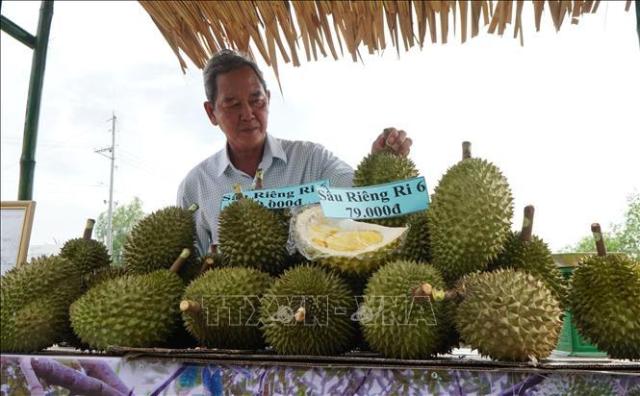
As China's tightened cadmium import standards disrupt durian exports from Vietnam's Dong Thap province, local authorities are looking to a "Korean-style soil restoration model" as a solution. The aim is to shift focus from agricultural expansion to improving soil quality itself.
According to Vietnamese media outlet Zing News on May 13, the Dong Thap People's Committee is establishing a laboratory to analyze agricultural soil quality and is developing a long-term plan for tailored improvement strategies for different crops. This initiative comes in response to China's strict enforcement of a cadmium limit of 0.05 mg/kg for imported fruits, increasing the demand for quality control from the production stage.
Nguyen Phuc Tien, vice chairman of the Dong Thap People's Committee, stated that the cadmium residues in durians are a result of long-term soil contamination from farming practices. He emphasized the need to review the management of cultivation area codes and promised strict measures against regions that do not comply with regulations. Additionally, he proposed a plan to periodically analyze soil samples by cultivation area, similar to practices in South Korea.
Deputy Minister of Agriculture and Rural Development Bo Van Hung also identified the source of the problem during a "2026 Export Promotion Meeting" held over the weekend. He noted that "the fundamental cause of cadmium contamination is primarily the residues left in the soil," stressing the need for soil improvement research, crop rotation, and control of input materials. He added that, in the short term, the management system would be refined to prevent logistics disruptions due to inspection delays.
Experts believe that the current situation reflects accumulated gaps in the management of fertilizers and pesticides. Nguyen Dang Nghia, former director of the Tropical Agriculture Research and Consulting Center, remarked that "the current crisis clearly shows the results of uncontrolled expansion in the durian industry over the years." He pointed out that cadmium naturally exists in soil and is also found in some fertilizers and pesticides. He explained that the high cadmium content in certain imported DAP fertilizers used in the Mekong Delta, along with saline intrusion at the end of the dry season and prolonged use of phosphate fertilizers, has compounded the issue.
In this context, South Korea's soil restoration policies are being presented as a reference model. This strategy focuses on improving soil quality rather than merely increasing production area. South Korean agriculture has transitioned from excessive use of chemical fertilizers and pesticides to prioritizing the restoration of natural soil fertility. In this process, organic fertilizers, compost, and microbial agents have been actively utilized to enhance organic matter content and beneficial microbial environments.
The core of the Korean model lies in a technology-based precision management system. Farmers regularly analyze their soil to assess nutrient content, pH levels, organic matter content, and chemical residue risks. Based on these results, specialized institutions provide specific recommendations on the types and amounts of fertilizers and cultivation methods. This approach allows for tailored management that reflects regional characteristics.
Nghia noted that soil restoration technologies have already been implemented in Vietnam. He described biochar as a high-carbon material created by pyrolyzing biomass in oxygen-limited environments, which can help stabilize pH and capture heavy metals when added to soil. He also mentioned that some companies are implementing models that combine cadmium-free selective fertilizers with biochar, which are gradually spreading to the Mekong Delta region.
Meanwhile, durian has already established itself as a key crop in Vietnam's agricultural exports. Thus, the cadmium issue is seen not merely as a one-time setback but as a turning point that could reshape the entire industry. Attention is focused on how the advanced agricultural policies modeled after South Korea, encompassing soil diagnosis, restoration, and cultivation area code management, will yield results in Dong Thap province.
* This article has been translated by AI.
Copyright ⓒ Aju Press All rights reserved.