
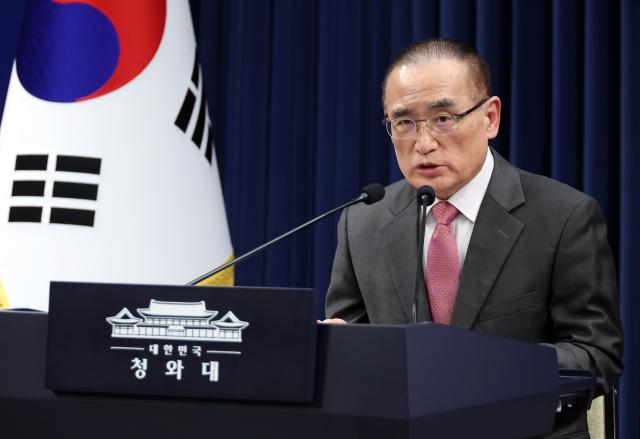
Wiesungrak, the Chief of the National Security Office, stated on May 17 that discussions regarding the transition of wartime operational control between South Korea and the United States are progressing, with both sides nearing agreement on the timing. "There is not a five to ten year gap between our positions; we are close to consensus on the timing of the transition," he said.
During an appearance on KBS's Sunday Diagnosis, Wiesungrak noted that military consultations are ongoing and that there are no significant differences in conditions or timing for the transition, emphasizing that it is fundamentally a political decision.
U.S. Forces Korea Commander General JB Vowell recently mentioned in a congressional hearing that the first quarter of 2029 is the target for the transition. Wiesungrak reiterated that the government's official stance is to aim for a swift transition within the current administration, adding that final details could be addressed at high-level talks between the leaders or their representatives.
He also mentioned that a roadmap for the transition will be developed in the second half of this year, and once full operational capability is verified, a proposal for the transition timing will be made. Discussions on the timing will then intensify, where compromises between the U.S. and South Korea will need to be found.
Regarding the strategic flexibility of U.S. Forces Korea, Wiesungrak explained that while the U.S. military operates under the command of the U.S. President, it also operates under South Korean sovereignty. Therefore, any flexibility exercised by the U.S. must respect South Korean interests.
In response to concerns that U.S. military movements could lead to diplomatic issues between China and South Korea in the event of a conflict in the Taiwan Strait, Wiesungrak stated, "If we maintain the framework of agreement and operational nuances between South Korea and the U.S., we can manage to avoid unwanted disputes, so this is not a major concern."
Wiesungrak also mentioned efforts to advance discussions on issues such as nuclear reprocessing and nuclear submarines between South Korea and the U.S., expressing hope to report positive developments soon.
Regarding the attack on the HMM Namooho in the Strait of Hormuz, Wiesungrak said, "I cannot say it was Iran, and it is not the right time to delve into who within Iran may be responsible." He added, "We have brought the necessary evidence to Seoul, and investigations are currently underway."
He concluded by stating, "We will quickly ascertain the facts and disclose them as soon as possible, taking necessary actions without any other considerations."
* This article has been translated by AI.
Copyright ⓒ Aju Press All rights reserved.