
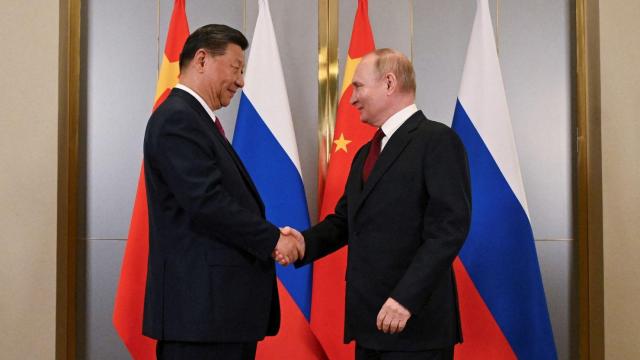
No sooner had President Donald Trump concluded his summit with President Xi Jinping and departed China on May 15, 2026 than news emerged that Russian President Vladimir Putin would arrive in Beijing almost immediately afterward.
On the surface, such a visit may not appear extraordinary. Putin has traveled to China many times before, and Sino-Russian summits have become familiar features of the geopolitical landscape.
Yet this visit feels fundamentally different.
The timing itself tells the story. That Putin is rushing to Beijing almost the moment the U.S.-China summit concludes suggests not confidence, but urgency. In international politics, true great powers project composure. Anxiety, especially visible anxiety, is often the first sign of diminishing strength.
The war in Ukraine has exposed Russia’s structural vulnerabilities to the world. The successor state to the Soviet Union — once the only power capable of rivaling the United States globally — still possesses vast territory and immense nuclear capabilities. Yet the prolonged conflict has revealed the limitations of Russia’s economic foundation, industrial structure, and technological competitiveness.
Most notably, the gap separating Russia from the world’s leading powers in semiconductors, artificial intelligence, aerospace systems, drones, and precision-guided weapons has proven far wider than many expected.
The deeper problem lies in Russia’s economic architecture itself. Despite its geopolitical ambitions, Russia remains heavily dependent on oil, natural gas, and mineral exports. Such a model may generate temporary strength when commodity prices are high, but it is poorly suited for the defining industries of the 21st century.
The emerging global order is increasingly driven by artificial intelligence, quantum computing, biotechnology, advanced semiconductors, and data infrastructure. In that race, Russia appears less like a future-oriented technological civilization and more like a resource empire struggling to preserve the remnants of past power.
The European Union faces a different, but equally revealing, predicament.
For decades, Europe was regarded as the world’s great civilian superpower — wealthy, stable, sophisticated, and morally influential. Yet the Ukraine war exposed profound structural weaknesses beneath that image. Europe’s industrial model had become deeply dependent on inexpensive Russian energy. Germany’s manufacturing engine has begun to lose momentum. France and Germany alike are facing weakening political leadership and rising internal fragmentation.
Militarily, Europe still depends heavily on the American-led NATO framework for its ultimate security guarantees.
As a result, the true geopolitical tigers of today’s world are no longer Russia and Europe, but the United States and China.
The United States continues to dominate the global financial system, the dollar-based monetary order, advanced AI platforms, semiconductor design, and military power projection. China, meanwhile, commands the world’s largest manufacturing ecosystem, critical supply chains, rare earth resources, battery production, electric vehicles, and an enormous domestic market.
The next tier of strategic powers may well belong not to Russia or Europe, but to Japan and South Korea.
Japan remains a global leader in semiconductor materials, precision machinery, robotics, and industrial systems. South Korea has established unmatched competitiveness in memory semiconductors, AI infrastructure, batteries, shipbuilding, and digital cultural industries. Together with Taiwan’s semiconductor ecosystem, Northeast Asia has effectively become the oil field of the AI age.
Russia and the European Union still possess military weight, historical prestige, and institutional influence. Yet in the decisive competition shaping the future — AI, platforms, semiconductors, and advanced technologies — they increasingly appear to be losing strategic momentum.
In that sense, one might argue that they are gradually becoming “paper tigers”: outwardly formidable, yet drifting away from the true engines of future power.
The recent U.S.-China summit symbolized precisely this transformation.
Trump and Xi reportedly discussed Taiwan, North Korea, Iran’s nuclear issue, global supply chains, and the battle for AI supremacy. These are not isolated diplomatic topics. Together, they reveal the emergence of a new G2 era — not the bipolarity of the Cold War, but a new order shaped simultaneously by technology, finance, supply chains, AI, and geopolitical influence.
In such an era, South Korea and Japan cannot afford to remain trapped indefinitely within the emotional architecture of 20th-century historical conflict.
The wounds of colonial history are real and must never be trivialized. Memory and historical responsibility remain essential. Yet civilizations cannot survive on resentment alone. History must be remembered, but the future cannot be built solely upon inherited anger.
The age of artificial intelligence is not merely a technological transition. It is ultimately a civilizational test. Humanity now faces a fundamental question: Will technology govern the human spirit, or will human wisdom govern technology?
This is why the coming era must become what might be called a “Spirituality-Centered AI” age — an era in which ethics, philosophy, culture, and spiritual intelligence guide technological power.
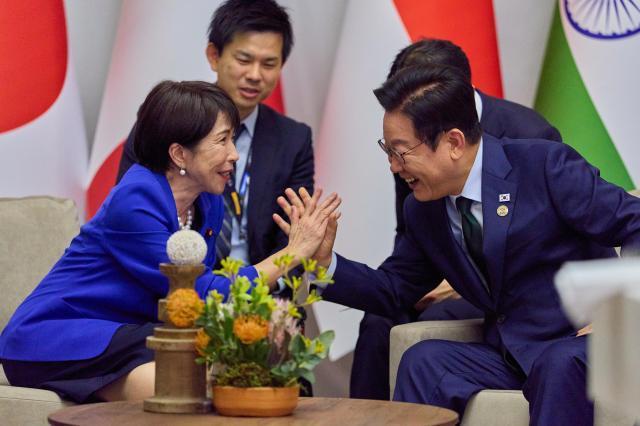
In this respect, South Korea and Japan represent a remarkably complementary partnership.
South Korea possesses extraordinary dynamism, digital adaptability, semiconductor strength, and cultural influence. Japan contributes precision engineering, foundational scientific depth, industrial discipline, and systemic stability.
Together, the two nations could form a civilizational and technological axis rivaled only by the United States and China.
More importantly, Korea and Japan share a deeper cultural inheritance rooted in Confucian, Buddhist, and East Asian traditions. Unlike purely hegemonic models of power, these traditions emphasize harmony, balance, restraint, coexistence, and moral order.
What Northeast Asia now requires is not politics imprisoned by yesterday’s emotions, but leadership capable of designing tomorrow’s civilization.
The forthcoming meeting between Prime Minister Sanae Takaichi and President Lee Jae-myung in Andong should therefore not remain a mere diplomatic ceremony. It should become the starting point for a genuine Korea-Japan economic and technological community.
The world is rapidly reorganizing itself into strategic blocs. The United States is consolidating North American supply chains. China is strengthening a Sinocentric economic sphere. Europe still operates through the EU single market. If Korea and Japan continue exhausting themselves in historical confrontation alone, both nations may ultimately become the greatest victims of their own division.
A Korea-Japan economic community should not be understood merely as a free-trade arrangement. It should encompass joint semiconductor supply chains, AI collaboration, energy security partnerships, shared research and development, educational exchanges, digital finance systems, and future-oriented industrial integration.
The I Ching (周易) offers a timeless insight:“When hearts are united, they can cut through metal.”
That may be precisely what Korea and Japan now require — the courage to remember the past honestly while still choosing cooperation for the future.
The most difficult obstacle, of course, remains the unresolved burden of history itself. Pain, suffering, and injustice cannot simply be erased. Yet civilizations do not endure through vengeance alone.
The Tao Te Ching (道德經) teaches: “Respond to resentment with virtue.”
Laozi’s wisdom was not naïve idealism. It was a philosophy of civilizational endurance — the belief that lasting order is built not upon endless retaliation, but upon moral restraint and higher equilibrium.
The Dhammapada (法句經) expresses the principle even more directly: “Hatred is never ended by hatred. It is ended only by compassion. This is an eternal truth.”
More than two thousand years later, those words remain painfully relevant to Northeast Asia.
The Bible offers a parallel truth in Romans: “Do not be overcome by evil, but overcome evil with good.”
This does not mean forgetting history. Rather, it means transcending the cycle of hatred in order to build a higher and more enduring order.
The world’s great scriptures speak in different languages, yet they point toward the same horizon: reconciliation over vengeance, coexistence over perpetual hostility, and the courage to create a future greater than the wounds of the past.
This is an age in which Trump, Xi, and Putin move the geopolitical chessboard. Yet the true challenge for Korea and
Japan is not merely how to react to great powers, but how to avoid becoming permanently trapped beneath them.
The time may finally have come for Korea and Japan to become a strategic axis of their own — not only for economic prosperity, but for the preservation of peace, balance, and civilizational wisdom in the AI age now unfolding before humanity.
Copyright ⓒ Aju Press All rights reserved.
