
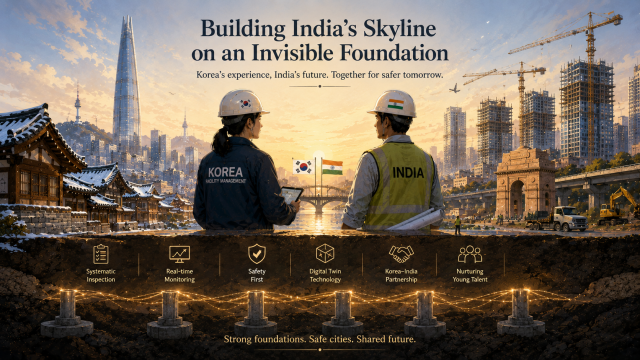
People often measure a city’s growth by the height of its skyscrapers. But from an engineer’s point of view, the true quality of a city is not about how high its buildings rise. It is about how safely those buildings can stand over time.
Korea experienced rapid growth over the past several decades, and through many painful lessons, we built a detailed system for facility maintenance and safety management. When I think about this experience meeting today’s India — a country now going through one of the largest construction booms in the world — I believe the future value both countries can create together is limitless.
India is currently one of the most dynamic countries in the world when it comes to building cities and infrastructure. Through projects such as the Smart Cities Mission and large-scale infrastructure development, roads, bridges, and high-rise buildings are being built every day.
But from the perspective of a facility manager, construction is never the end point. It is only the beginning of a very long journey that may continue for decades.
If the skill of raising a building is called “construction,” then the skill of keeping that building safe and alive for many years is called “facility management.”
India’s construction market is expanding at an incredible speed, but the need for systematic maintenance and safety standards is growing just as quickly. As more structures are built, the importance of preventing large accidents and managing facilities properly becomes even greater.
This is where a new form of trade between Korea and India can begin.
In the past, trade mainly meant exchanging visible goods. But the trade of the future should involve sharing invisible values such as systems, knowledge, and safety.
Korean facility management organizations have built strong experience in areas such as maintenance history systems, standardized inspections, and real-time monitoring technology. These systems could become powerful support for India’s massive infrastructure network.
In particular, Korea’s advanced digital twin technology could work very well with India’s smart city projects. By creating virtual versions of real buildings, engineers can predict aging and risks before problems appear in real life.
This is perhaps the most ideal form of cooperation: Korea’s advanced software technology meeting India’s enormous hardware market.
I dream of a future where India’s talented young engineers learn Korea’s advanced facility management methods and apply them across infrastructure sites throughout India.
Korea now needs new opportunities to share the knowledge and experience of its skilled safety experts, while India has a large and energetic workforce ready to absorb this expertise and protect the safety of its citizens.
Indian engineers could manage their country’s growing skylines with the safety philosophy they learned from Korea, while Korea could continue improving its own maintenance technologies using the huge amount of data created through India’s expanding infrastructure projects.
This would create a cycle where both countries grow together.
More importantly, this is not only about technology. It is about sharing a culture that values human life and public safety above all else. In that sense, it is both a cultural partnership and a new form of trade.
Facility management is never glamorous. It is a field that receives attention only when accidents do not happen. It works quietly in the shadows.
But the stronger and deeper those shadows are, the brighter and taller the city above them can shine.
Just as the Embassy of India and the Indian Cultural Centre have helped reduce the emotional distance between Korea and India, I believe the future relationship between the two countries should now grow further through practical cooperation in safety and infrastructure management.
The small crack we inspect today may become the foundation for a much safer future tomorrow. In many ways, this idea closely reflects the theme of this contest: “Our Moments and Future.”
When Korea’s experience and India’s energy come together to build a stronger foundation of safety, everyday life for Indian citizens will become more secure, and Korea’s safety industry will also gain new opportunities in the global market.
I hope the sky we build together over India will be filled not with clouds of anxiety, but with the clear wind of trust.
I truly believe that the path Korea and India walk together will ultimately become a road leading humanity toward a safer and more prosperous future.
And I hope that the sincerity I have carried while quietly protecting people’s safety from unseen places will someday grow into something even greater above India’s rising skyscrapers.
*The author, Choi Ji-su, is based in Korea. The author's writing was submitted in Korean, and was translated into English by AI.
Copyright ⓒ Aju Press All rights reserved.
