
As Pyongyang rewrites its constitution to erase the prospect of reunification, a women's soccer tournament in Suwon serves as the final point of contact between two hostile states.
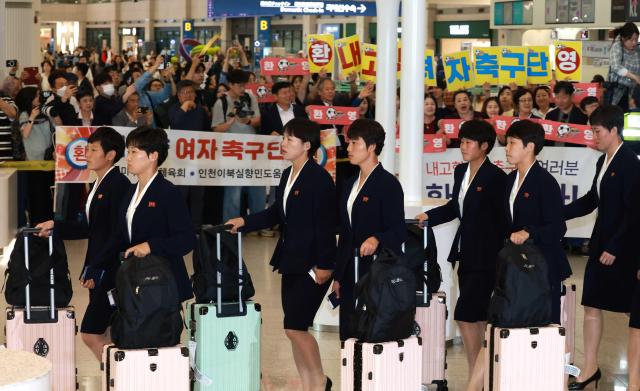
At 2:20 p.m. on Sunday, 27 players and 12 staff members wearing matching tracksuits disembarked an Air China flight at Incheon International Airport. They collected their luggage, cleared customs, and boarded buses bound for the Gyeonggi provincial capital. The arrival of a visiting club for the Asian Football Confederation Women’s Champions League semifinals would typically disappear into the routine logistical hum of the South Korean transit system. But the Naegohyang Women’s F.C. had just traveled from Pyongyang via Beijing, traversing a geopolitical boundary that has never been more heavily militarized.
When they step onto the pitch against Suwon F.C. Women on Wednesday, it will mark the first time a North Korean sports delegation has entered the South in eight years. The fixture is entirely devoid of diplomatic optimism. We are observing an isolated autocracy that has systematically eradicated every other form of contact with Seoul—severing telecommunications, rewriting its fundamental laws, and detonating physical monuments to peace. Pyongyang has dispatched a soccer team across a border it no longer recognizes as a temporary division, treating it instead as a permanent frontier. The playing field in Suwon south of Seoul is the final operational coordinate where the two Koreas interact.
To comprehend the structural friction of this week’s tournament, the rapid dismantling of the inter-Korean apparatus must be examined first. The current communications blackout was initiated on April 7, 2023. At nine in the morning on a Friday, Pyongyang ceased answering the daily administrative calls on the inter-Korean joint liaison office and the military communication lines. These networks were designed to coordinate logistics and prevent accidental naval skirmishes in the volatile West Sea. The receivers in Freedom House have remained dead ever since.
That silence preceded a profound doctrinal shift. By early 2024, Kim Jong-un discarded the state doctrine of peaceful reunification that had governed North Korean policy for decades, formally declaring South Korea a principal enemy. The rhetoric materialized into immediate physical action. Pyongyang demolished the Arch of Reunification—a towering stone monument erected by his father in the capital—and began laying thousands of fresh landmines along the Demilitarized Zone. The regime shifted its posture from managing a divided peninsula to fortifying a hardened national border.
In March 2026, the Supreme People’s Assembly codified this rupture into the highest law of the land. The legislature scrubbed the concepts of ethnic unity and reconciliation from the North Korean constitution. They formally defined their territorial boundaries, legally designating the Republic of Korea as a foreign adversary rather than a separated brother. The regime even petitioned the International Civil Aviation Organization to terminate the inter-Korean air traffic control network, an administrative link that had previously survived severe military standoffs and nuclear tests.
This structural severance makes the presence of the Naegohyang squad at the Suwon Sports Complex jarringly anachronistic. In previous decades, sports diplomacy functioned as the vanguard of a broader geopolitical thaw. When a unified Korean team won gold at the World Table Tennis Championships in Chiba in 1991, or when athletes marched together behind a pale blue Unification Flag at the Sydney Olympics in 2000, both capitals nominally subscribed to the prospect of eventual unity. Even the hastily assembled women's ice hockey team at the Pyeongchang Winter Olympics eight years ago provided the diplomatic cover required for a series of historic summits between Pyongyang, Seoul, and Washington.
Today, there is no broader thaw on the horizon. The diplomatic utility of the Suwon match is negligible. President Lee Jae Myung’s repeated offers to restore basic dialogue and resume humanitarian aid have been met with total indifference. North Korea has no intention of utilizing 90 minutes of soccer to restart nuclear negotiations or arrange a border summit. For Mr. Kim, international sports offer a highly specific utility. Fielding a competitive women’s team allows Pyongyang to project normalcy, discipline, and national prestige on the global stage without compromising its hardened borders or exposing its citizens to the corrosive influence of South Korean economic realities.
For South Korea, playing the host presents a complex administrative and political burden. It forces a democratic society—currently managing intense regional security anxieties, currency fluctuations against the dollar, and the ongoing pressure to maintain semiconductor sovereignty in a fractured global market—to accommodate representatives of a regime that openly targets its infrastructure. The host nation must adhere to the polite fictions of international sporting protocol, offering training facilities, logistics, and heavy security details to a state that refuses to pick up a telephone to de-escalate live military tensions.
The stadium in Suwon will be filled with security personnel, government observers, and global media, all monitoring a fixture governed by strict, mutually agreed-upon laws. The athletes themselves are deployed simply to win a soccer match. They are tasked with navigating an environment where every technical foul, substitution, and post-match handshake will be analyzed for political signaling. The Naegohyang players spent days training in isolation near their embassy in Beijing before securing passage to Seoul, highlighting the convoluted logistics required to move civilians across a sealed perimeter. They operate within a performative contradiction, executing a tactical game plan while their respective defense ministries prepare for worst-case scenarios along the 38th parallel.
When the referee blows the whistle to initiate the semifinal, it will trigger a brief, localized suspension of the geopolitical reality that defines the Korean Peninsula. For an hour and a half on a manicured patch of grass, the two hostile states will subject themselves to the exact same set of rules—only to walk off the pitch, board their respective buses, and return to a reality where the concept of a shared existence has been entirely erased.
Copyright ⓒ Aju Press All rights reserved.
