
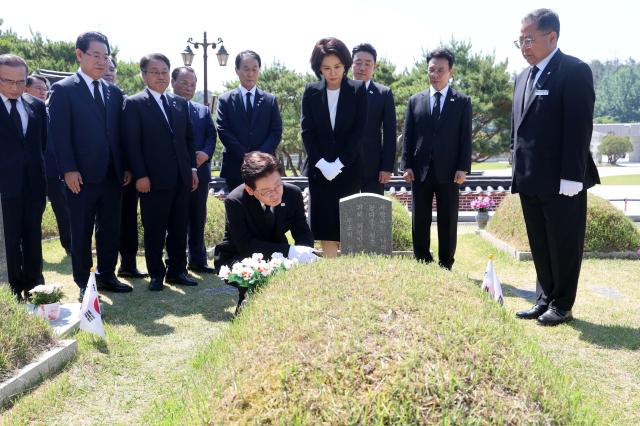
The ceremony was organized to honor the spirit of citizens and students who resisted military dictatorship to protect democracy 46 years ago and to console the families of the victims.
This year's memorial marks the first since the establishment of the people's sovereignty government and was themed "May, Embracing the Plaza Again." The theme reflects a commitment to remember the solidarity and sacrifices shown in Gwangju in May 1980 and to continue the spirit of May together.
Notably, the ceremony took place at the newly opened 5·18 Democracy Square, which has been under restoration since 2019. This historic site was where various rallies were held during the Gwangju Uprising, using the fountain in the square as a podium.
Approximately 3,000 people attended the ceremony, including 5·18 democracy activists, their families, government officials, and citizens, to commemorate the victims of the Gwangju Uprising and express their gratitude.
Before the ceremony, President Lee and First Lady Kim Hye-kyung paid their respects at the 5·18 Memorial Tower in the National 5·18 Democratic Cemetery in Gwangju, alongside leaders of 5·18 civic organizations and representatives of the victims' families. They also visited the graves of three martyrs, including Park In-bae, to honor their memory and express gratitude.
The ceremony included a national tribute, a thematic video, commemorative speeches, a special performance for the opening of the former Jeonnam Provincial Office, and a rendition of the song "March for the Beloved."
The thematic video vividly depicted the events of the Gwangju Uprising through archival footage and interviews, followed by a declaration from three leaders of 5·18 civic organizations pledging to carry on the spirit of May.
The commemorative performance featured actors and a theater troupe reading poetry, novels, and diaries symbolizing the spirit of May, concluding with attendees standing to sing "March for the Beloved."
The Gwangju Uprising was a popular uprising that took place from May 18 to 27, 1980, when citizens of Gwangju rose against military dictatorship to defend democracy. On May 25, 2011, documents and photographs related to the Gwangju Uprising were registered as UNESCO World Documentary Heritage.
* This article has been translated by AI.
Copyright ⓒ Aju Press All rights reserved.