
The ongoing conflict in the Middle East, combined with climate factors, is creating significant energy shocks. With the blockade of the Strait of Hormuz halting oil exports from the Gulf region, global oil inventories are rapidly depleting. The potential for increased demand due to summer cooling and travel, along with a strong El Niño, has led to warnings that international oil prices could rise to $180 per barrel (approximately 260,000 won).
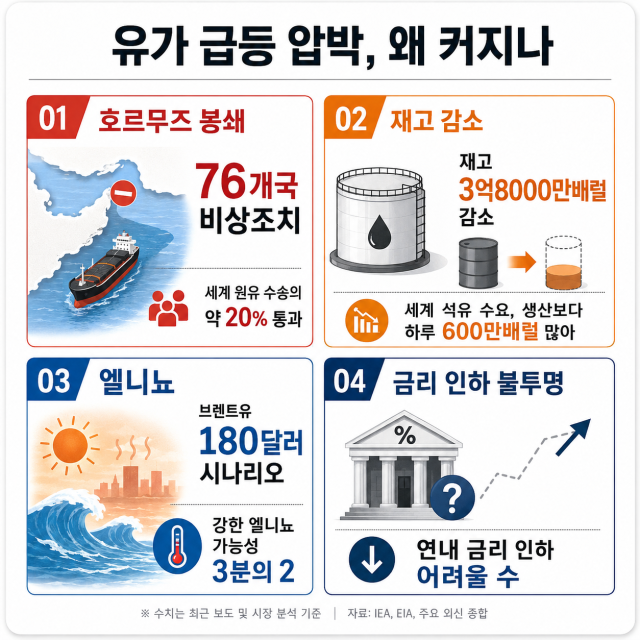
According to the Financial Times (FT) on May 17, the International Energy Agency (IEA) estimates that the number of countries implementing emergency measures for fuel security and consumption restraint has risen to 76, up from 55 at the end of March. This increase occurred within just two months.
Australia plans to invest $10 billion (about 14.7 trillion won) to expand its fuel and fertilizer reserves, while India is advising its citizens to refrain from gold purchases and international travel to defend its foreign exchange reserves.
Countries are responding urgently as energy supplies tighten. The IEA projects that from March to June, global oil demand will exceed production by about 6 million barrels per day. Some analysts estimate the shortfall could reach 8 to 9 million barrels daily. Since the onset of the conflict, global oil inventories have decreased by approximately 380 million barrels, excluding amounts that could not leave the Gulf region.
Releasing government reserves has its limits. Currently, more than 2 million barrels of emergency oil are being supplied to the market daily, but many of these release measures are set to end in July. JP Morgan warns that the inventories of OECD member countries could drop to levels that strain oil distribution and refinery operations by early June.
The forecast of $180 per barrel arises from these circumstances. Paul Diggle, chief economist at Aberdeen Asset Management, stated, "We are considering a scenario where Brent crude could rise to $180 per barrel (approximately 260,000 won)." He noted that while this is not his base case, it is a serious consideration.
Currently, Brent crude is priced above $105 per barrel (about 150,000 won). However, analysts suggest this level may not exert enough price pressure to significantly reduce oil consumption. Morgan Stanley warns that if prices exceed $150 (about 220,000 won), it could lead to actual fuel shortages, supply chain disruptions, and a simultaneous economic recession.
A key variable is the reopening of the Strait of Hormuz. Apostolos Tzitzikostas, the European Union's Commissioner for Transport, cautioned at an FT conference that if the Middle East conflict does not resolve within weeks and the Strait remains closed, the possibility of a global recession cannot be ruled out. In this scenario, the volume of oil reaching the market becomes more critical than production levels.
El Niño Complicates Matters
Adding to the uncertainty is the emergence of El Niño. According to CNN, the National Oceanic and Atmospheric Administration (NOAA) reports that El Niño is forming more rapidly than expected, with a significant likelihood of developing into a strong event this fall or winter. NOAA estimates a two-thirds chance that this El Niño could reach strong or very strong levels at its peak, with a 96% probability of lasting through winter.
El Niño is characterized by higher-than-average sea surface temperatures in the tropical Pacific, which can alter global weather patterns. A strong El Niño increases the risks of droughts, heatwaves, and floods in various regions. Heatwaves can lead to higher air conditioning use, increasing power demand, while droughts can worsen conditions for hydropower generation. Increased reliance on oil, gas, and coal to meet energy needs could further pressure overall energy prices.
Rising oil prices also pose challenges for monetary policy. Jeffrey Gundlach, CEO of DoubleLine Capital and known as the 'Bond King,' stated that rising oil prices and tariff burdens due to the Middle East conflict could push inflation higher, complicating the Federal Reserve's ability to cut interest rates this year. He suggested that the next Consumer Price Index (CPI) could rise to around 4%, indicating that the Fed's next policy move might be an increase rather than a decrease.
* This article has been translated by AI.
Copyright ⓒ Aju Press All rights reserved.