
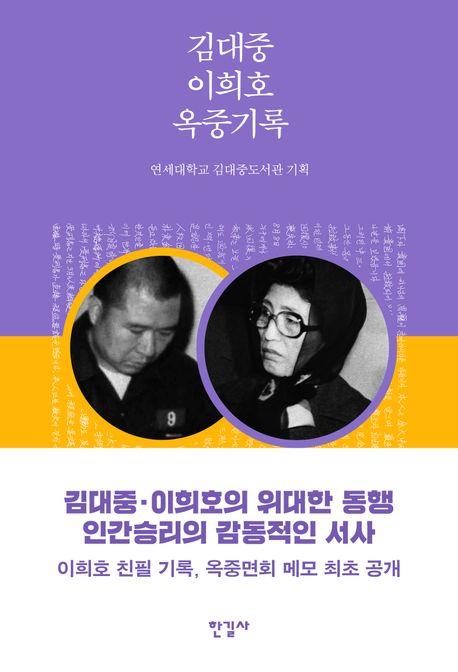
Kim Dae-jung Lee Hee-ho Imprisonment Records=Planned by Yonsei University Kim Dae-jung Library, published by Hangilsa.
A new book reflecting on the political life of former President Kim Dae-jung has been released. Following Kim Dae-jung's Oral Memoirs and Kim Dae-jung's Exile Diary, this book includes the imprisonment records of Kim Dae-jung and his wife, Lee Hee-ho. The book focuses on the years from 1976 to 1982, during which Kim was imprisoned due to the March 1st Democratic Declaration and the 1980 conspiracy case. It vividly conveys the tense atmosphere of the time through Lee's notes, letters, international rescue efforts, and court records.
As Kim's political partner, Lee sent letters to the international community advocating for her husband's human rights and release. Twenty documents, including his prison visitation notes and letters sent to domestic and international figures, are published for the first time in this book.
Lee served as a 'window' connecting Kim Dae-jung with the outside world during his imprisonment. During his incarceration, she was allowed only one 10-minute visit per month, during which she summarized international news and current events. Lee provided Kim, who had no access to newspapers or magazines, with crucial information on inflation rates, international oil prices, loan issues, and diplomatic matters, helping him maintain a sense of the era and reality even while imprisoned.
Additionally, she worked tirelessly to inform the international community about Kim's situation, seeking ongoing support from foreign political leaders such as U.S. Senator Edward Kennedy and Japanese Prime Minister Takeo Miki, as well as international human rights organizations.
Park Myung-rim, director of the Kim Dae-jung Library, stated at a press conference on May 14, "Every time we investigated records from President Kim's imprisonment, Lee Hee-ho's name was always mentioned. Therefore, the title of the book had to be 'Kim Dae-jung and Lee Hee-ho Imprisonment Records.'" He added, "Her regular communication with the U.S. Embassy and her sharp, high-level information and judgment were remarkable. Lee Hee-ho's English skills, deep knowledge of international affairs, and Christian network made this possible."
Kim Gi-man, head of external cooperation at the Kim Dae-jung Political School, recounted, "When Lee visited Kim Dae-jung in Gwangju Prison in 1980, she told him, 'If you kneel to Chun Doo-hwan, I will divorce you.' Kim later confessed, 'That statement became my outlook on life.'"
"In 1981, the economic situation: 1) GNP grew by 7.1%, per capita income was $1,636 (the same level as 1979) 2) Inflation rate: wholesale 11.8%, retail 12.6% 3) Money supply increased by 25.2% 4) Exports totaled $21 billion, imports $26.3 billion, trade deficit $5.3 billion 5) Total external debt reported at $33 billion. Oil import cost $7 billion (11%), external debt principal and interest repayment $3.5 billion (6.3%), grain imports $2.1 billion (3.3%)." January 20, 1982, Lee Hee-ho's prepared prison visitation notes (page 293)
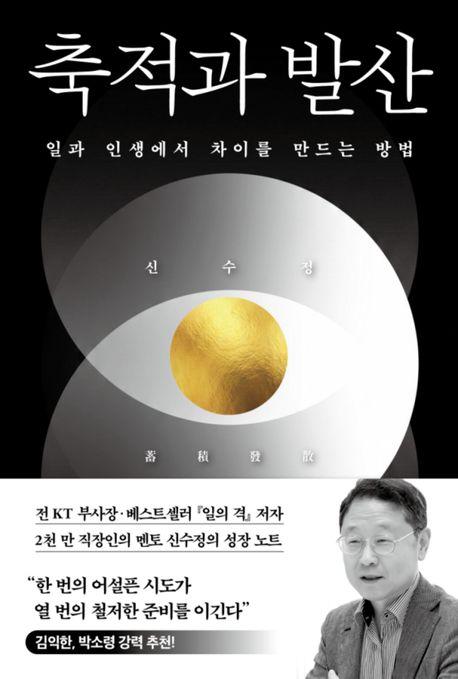
Accumulation and Dissemination=Written by Shin Soo-jung, published by Woongjin Knowledge House.
The author, a former vice president of KT, presents 'accumulation and dissemination' as the key to making a difference in work and life. The essence is that one should not only focus on quietly building skills through 'accumulation' but also actively showcase their capabilities to be discovered by others through 'dissemination.' The author emphasizes the need to move away from vague expectations that opportunities will come on their own and instead strategize to create opportunities.
Above all, the author advises, 'Start lightly.' By taking some risks and opening oneself to the world, one can discover and address their weaknesses. The cycle of accumulation and dissemination is achieved through small actions and adjustments. This process can elevate potential in both work and life. The book conveys this message along with various books and examples, presenting the mindset and strategies needed in a changing era.
"Set your intentions and make plans. However, do not blame yourself if plans go awry. Keep an open mind with curiosity, optimism, perseverance, and flexibility, and take some risks. By continuously learning, experimenting with various possibilities, meeting people, and giving first, the likelihood of unexpected opportunities and connections increases. When opportunities arise, you can adjust your plans accordingly. In the rapidly changing future, a compass that indicates direction is more important than a detailed map." (page 30)
* This article has been translated by AI.
Copyright ⓒ Aju Press All rights reserved.