
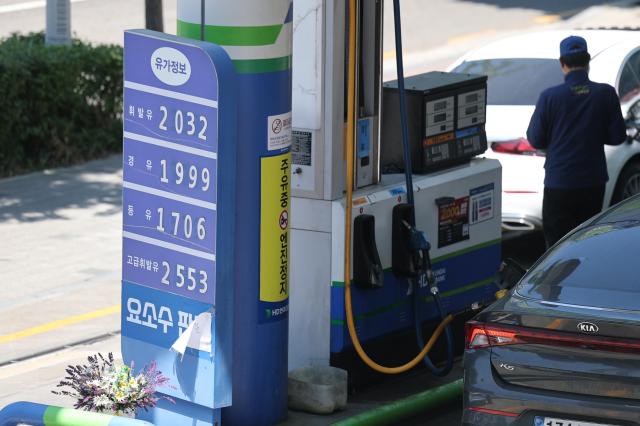
Oil price information displayed at a gas station in Seoul on May 5, as international oil prices surge. [Photo=Yonhap News]
International oil prices have remained above $100 per barrel for an extended period, intensifying accumulated inflationary pressures. While the government has managed to suppress immediate price increases, there are concerns that rising import costs may eventually impact the domestic economy.
As of May 18, Brent crude for July delivery rose 1.98% to $111.42 per barrel, while West Texas Intermediate (WTI) for June delivery increased by 2.43% to $107.98, marking the highest price this month.
International oil prices averaged $128.52 per barrel in March and $105.70 in April, and they have continued to hover around the $100 mark in May. Brent crude has been above $100 since April 23, and WTI has remained at that level since May 11.
The prolonged high oil prices are gradually amplifying inflationary pressures. Although import prices temporarily decreased last month, the overall inflation burden remains significant. According to the Bank of Korea, the import price index for April was 168.12, down 2.3% from the previous month. However, this decline was largely due to a base effect from a 16.1% surge in March. Compared to the same month last year, April's import prices were still 20.2% higher.
With oil prices maintaining above $100 in May, analysts suggest that the accumulated import cost burden is likely to be reflected in consumer prices with a time lag. The government has implemented measures such as a cap on oil prices and a reduction in fuel taxes to mitigate short-term inflationary pressures, but companies are gradually facing increased cost burdens.
The Korea Development Institute (KDI) has indicated that rising oil prices due to transportation uncertainties could elevate this year's consumer price inflation rate by 1.0 to 1.6 percentage points, with the possibility of high inflation persisting into next year.
The Bank of Korea is also expected to revise its inflation rate forecasts upward in its upcoming economic outlook. The central bank has projected consumer price inflation rates of 2.2% for this year and 2.0% for next year. Earlier, KDI significantly raised its inflation forecast for this year from 2.1% in February to 2.7% this month.
High oil prices are anticipated to exert pressure not only on inflation but also on the current account balance. As a major oil-importing country, South Korea faces increased dollar expenditures for the same volume of crude oil, leading to a heightened energy import burden. This is likely to result in a reduced trade surplus. Additionally, since most oil transactions are conducted in dollars, the increased demand for dollars by companies is also a concern.
If rising fuel and electricity prices coincide, it could lead to a decrease in real household income, increased cost burdens for businesses, and a potential slowdown in investment, heightening the risk of domestic economic contraction. Analysts warn that prolonged high oil prices could trigger stagflation, characterized by simultaneous inflation and economic slowdown.
Kim Jin-sung, a researcher at Heungkuk Securities, stated, "Private consumption is influenced by a complex interplay of factors, including expectations for economic recovery, policy support, inflationary pressures, and geopolitical uncertainties. If conflicts in the Middle East persist, the economic shocks following rising oil prices are likely to intensify."
* This article has been translated by AI.
Copyright ⓒ Aju Press All rights reserved.