
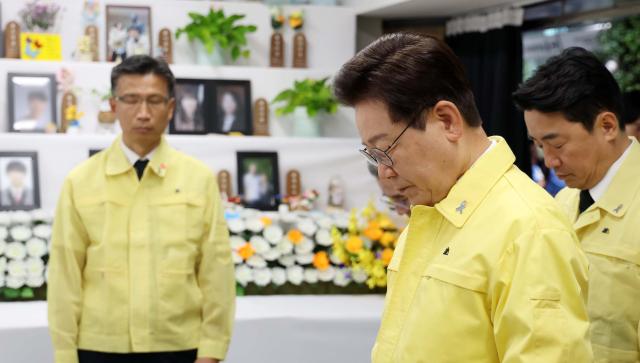
In a post on X (formerly Twitter), President Lee emphasized, "Workers should receive fair compensation for their labor, while shareholders who bear risks and losses deserve a share of corporate profits." He noted that at one time, the Constitution included provisions for workers' rights to share in corporate profits.
The right to share in corporate profits was outlined in Article 18, Section 2 of the original Constitution, which stated that employees of profit-oriented private enterprises had the right to equitable distribution of profits as determined by law. This provision was removed during the 1962 constitutional amendment process.
President Lee also suggested the possibility of invoking "emergency adjustment rights," stating, "While the current Constitution guarantees the basic rights of all citizens, these rights may be restricted for public welfare as long as the essential content is not violated." If invoked, emergency adjustment rights would prohibit strikes for 30 days.
He remarked, "Where there is light, there is shadow; where there is a mountain, there is a valley. Excess can be as detrimental as deficiency, and extreme situations often lead to a backlash." His reference to excess is interpreted as a response to the Samsung union's demands for the elimination of the cap on performance bonuses, which they seek to set at 50% of annual salary, and for a formalization of a plan to allocate 15% of operating profit for bonuses.
President Lee urged for dialogue between labor and management, stating, "Having more power does not equate to greater happiness; a future for a new South Korea lies in solidarity and shared responsibility for a better life for all."
Labor Minister Kim Young-hoon responded to the President's message on social media, stating, "We will ensure that labor negotiations contribute to the healthy development of the national economy." He added, "The spirit of solidarity shown during the May 1980 Gwangju uprising is more relevant today than ever, and we will strive to ensure that labor negotiations lead to fair compensation and help alleviate polarization in the economy."
On the same day, the business community issued a joint statement urging the Samsung union to withdraw its strike plans and calling for the immediate activation of emergency adjustment rights if a strike occurs. Six business organizations, including the Korea Employers Federation, the Korea Chamber of Commerce and Industry, and the Korea International Trade Association, expressed deep concern over the union's insistence on its existing position despite government and labor committee efforts, stating, "A strike by the Samsung union would undermine the foundation of a key national industry, and the union must withdraw its strike plans and seek resolution through dialogue."
The business community emphasized that the issue of performance bonuses should be considered a management decision rather than a subject of collective bargaining, warning that excessive demands from some unions could exacerbate the dual structure of the labor market and increase social discord.
* This article has been translated by AI.
Copyright ⓒ Aju Press All rights reserved.