
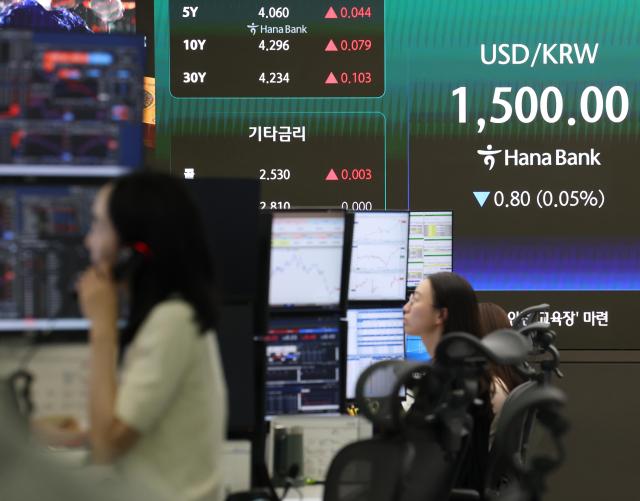
The won-dollar exchange rate has surpassed the 1500 mark for the first time in a month, reflecting heightened volatility in the foreign exchange market. This surge is attributed to a combination of strong dollar pressures, significant foreign investor capital outflows, and rising international oil prices.
On May 18, the weekly closing rate for the won against the U.S. dollar in the Seoul foreign exchange market was recorded at 1500.3 won, down 0.5 won from the previous trading day. Despite this slight decline, the rate remains firmly above the 1500 won level. Earlier this month, on May 6, the rate had dipped to 1439.6 won, suggesting a brief period of stability, but volatility has since intensified.
The recent spike in the exchange rate is rooted in deteriorating global macroeconomic conditions. The sharp decline of the British pound has contributed to upward pressure on the dollar. Additionally, the recent U.S.-China summit ended without significant outcomes, increasing market uncertainty surrounding conflicts in the Middle East. Concerns over inflation in the U.S. have also heightened expectations of further tightening by the central bank. Furthermore, rising international oil prices due to escalating tensions in the Middle East have raised fears of worsening trade balances for South Korea, which is heavily reliant on energy imports, thereby exerting downward pressure on the won.
From a supply and demand perspective, the outflow of foreign investment has been a primary driver of the rising exchange rate. Foreign investors have sold a net 23.55 trillion won in the stock market over the past seven trading days. Cumulatively, the net selling during the trading days of May 15 and 18 reached 9.23 trillion won. The rise in domestic bond yields, coupled with internal issues at major companies like Samsung Electronics, has significantly dampened investor sentiment toward South Korean assets. This has led to increased demand for currency exchange related to foreign stock sales, directly pushing up the exchange rate.
Despite the won surpassing the 1500 mark, there has been no visible intervention from foreign exchange authorities. The Governor and Deputy Governor of the Bank of Korea have maintained a cautious stance, asserting that exchange rates should be determined by market forces and that artificial intervention is inappropriate. In fact, during the surge in March, any verbal or actual intervention by authorities was limited. However, the recent exchange rate decline has been interpreted as a response to growing expectations of intervention by foreign exchange authorities.
Financial market experts believe that the current exchange rate level presents significant pressure, suggesting that the potential for further sharp increases is limited. Moon Da-un, a researcher at Korea Investment & Securities, stated, "Given the current level of 1500 won, which is a significant figure, and the previous peak of 1536 won after the war, this range carries a high likelihood of government intervention, indicating limited room for further increases."
* This article has been translated by AI.
Copyright ⓒ Aju Press All rights reserved.