
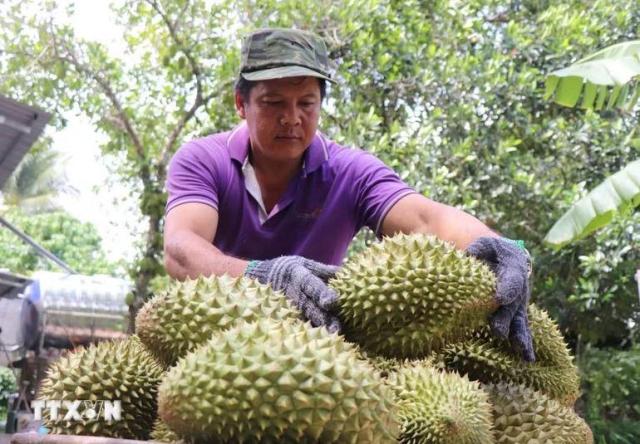
In the first quarter of this year, Vietnam's durian exports skyrocketed by 230% compared to the previous year, showing a strong recovery. Growth in new markets such as South Korea and the United States is notable, but challenges remain, including high dependence on China, cadmium contamination issues, and price instability.
According to Vietnam's Ministry of Agriculture and Rural Development on May 17, durian exports reached approximately $221.7 million (about 333.3 billion VND) in the first quarter, marking a 230% increase year-on-year. Total export volume exceeded 80,000 tons, with fresh durian accounting for about 68,500 tons and frozen durian about 11,600 tons. The surge in export value is primarily driven by frozen durian, which saw an average export price of around $4,302 per ton (approximately 6.46 million VND), over 20% higher than the previous year and 18-22% more than fresh durian.
In addition to traditional markets like China, significant growth has been observed in various importing countries. Exports to South Korea surged by 262%, the highest growth rate, while exports to the United States increased by over 107%. Australia and Japan also saw increases of 40% and 12%, respectively. This indicates a growing presence of Vietnamese durian in demanding markets.
◆ China Absorbs 90% of Fresh Durian Exports, Price Instability Persists
However, the outlook for future durian exports is not entirely optimistic. China remains the largest market, absorbing about 90% of Vietnam's fresh durian exports. The inconsistency of China's quarantine and purchasing policies leads to repeated price fluctuations. Cases of contamination with harmful substances like cadmium and O-aminophenol continue to occur, disrupting exports to China.
Currently, sources from southern production and distribution areas report that the Ri6 variety is priced at 40,000 to 49,000 VND per kilogram (about $2.20 to $2.70), an increase of 5,000 to 7,000 VND from the previous week. In contrast, the Thai variety (Monthong) has decreased by about 3,000 VND, priced at 76,000 to 81,000 VND per kilogram.
Dang Phuc Nguyen, Secretary-General of the Vietnam Vegetable and Fruit Association, stated, "The recent recovery in durian prices is due to a temporary stabilization of exports to China and a reduction in the supply of the Ri6 variety from the Mekong Delta region." However, he cautioned that the issues of cadmium and O-aminophenol contamination remain unresolved, which could lead to renewed export restrictions to China. Additionally, overlapping harvest times with Thai varieties are major factors contributing to price instability.
Following the harvest in the southwestern Mekong Delta, large-scale shipments of Thai varieties (Monthong) are expected primarily from the southeastern region between May and July, and from the western highlands between August and November, raising concerns about potential price declines in the second half of the year. Experts emphasize the urgent need for zoning of cultivation areas, systematic management, enhanced cadmium testing capabilities, and standardization of cultivation processes.
Meanwhile, the Vietnamese government is taking strong measures to address structural weaknesses in the durian export certification system. On May 15, Deputy Prime Minister Ho Duc Phoc convened relevant ministries to request that the Ministry of Public Security investigate broker activities related to cultivation codes, code trading and leasing, and manipulation of inspection results. This comes after 403 cultivation codes and 240 packaging facility codes received non-compliance warnings from China since 2025, indicating that misuse and false usage of codes are undermining export credibility.
The Deputy Prime Minister remarked, "If control is not properly implemented, we will see repeated price crashes during bumper harvests, ultimately harming farmers the most." He also directed the simplification of the cultivation code issuance process, decentralization of authority, and further negotiations with the General Administration of Customs of China for additional code approvals.
* This article has been translated by AI.
Copyright ⓒ Aju Press All rights reserved.