
Amid a declining birth rate, leading education companies in South Korea are expressing a sense of crisis, stating they are at a "survival crossroads." The drop in birth rates directly impacts the school-age population, which is essential for the education market. Facing slowed growth, major education firms are seeking solutions through global expansion driven by artificial intelligence (AI) and edtech, as well as diversifying their portfolios to include senior care and lifelong learning.
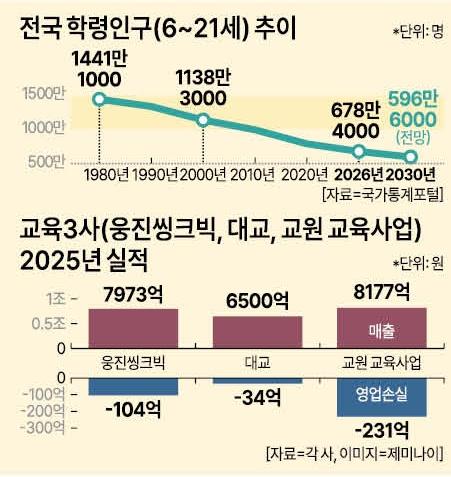
According to the National Statistical Portal, the school-age population (ages 6 to 21) is estimated at 6.784 million this year. This figure has been on a steady decline since peaking at 14.411 million in 1980. By 2030, the school-age population is projected to fall below 6 million, reaching approximately 5.966 million.
The population crisis poses a "survival challenge" for education companies that have traditionally relied on this demographic for growth. Their core education business has been struggling, as evidenced by recent financial reports. For instance, Woongjin ThinkBig reported a consolidated revenue of 797.3 billion won in 2025, down 8.1% from 867.1 billion won the previous year. Its operating profit shifted from a profit of 9.2 billion won to an operating loss of 10.4 billion won.
During the same period, Daekyo's revenue decreased by 2.03%, from 663.5 billion won to 650 billion won, with operating losses increasing from 1.6 billion won to 3.4 billion won. Kyowon Group's education division also saw a revenue drop of 5.5%, from 865.4 billion won to 817.7 billion won, while its operating losses expanded from 16.2 billion won to 23.1 billion won.
In response to the declining school-age population, education companies are accelerating efforts to explore new markets as a necessary growth engine.
Woongjin ThinkBig is targeting high-value overseas markets with its proprietary edtech and metaverse educational tools. Notably, its generative AI-based reading solution, Booxtory, won the Best Innovation Award in the AI category at CES 2025, positioning the company to challenge markets in the U.S., Japan, and Taiwan.
Additionally, the company is increasing exports of its augmented reality reading platform, ARpedia, which is already available in 24 countries, to boost its technology-driven performance.
Daekyo is shifting its focus to the Korean language education market, targeting multicultural families and foreign residents in South Korea. The company has developed specialized courses for the Test of Proficiency in Korean (TOPIK) and created dedicated learning platforms, significantly broadening its target audience to include foreigners living both domestically and abroad.
The senior care and funeral service sectors have become another competitive arena for the big three education companies. Last year, Woongjin acquired Fried Life, the leading funeral service provider in South Korea, for approximately 883 billion won, rebranding it as Woongjin Fried Life and quickly becoming the top player in the funeral industry.
Kyowon established Kyowon Life in 2011, solidifying its position as a top competitor in the sector by employing a hybrid strategy that combines home appliances and educational services.
Daekyo has launched a senior-focused brand, Daekyo New Life, and has built a nationwide franchise network for home care and daycare centers. The company is aggressively expanding its influence in related services, including funeral services and AI care calls.
An industry insider noted, "The rapid decline in the school-age population means that if we remain idle, we will inevitably face extinction. By exporting K-edutech to generate high profits and simultaneously entering the senior and funeral service sectors in a super-aged society, a two-track strategy will become the standard survival formula for the education industry."
* This article has been translated by AI.
Copyright ⓒ Aju Press All rights reserved.