
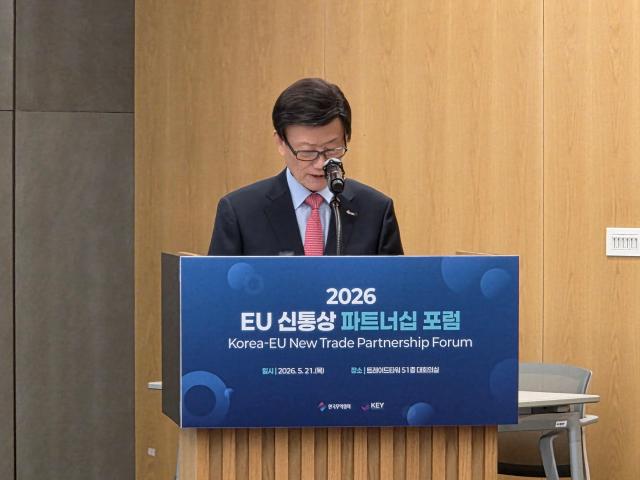
As the European Union's (EU) environmental regulations, including the Carbon Border Adjustment Mechanism (CBAM), intensify, the Korea International Trade Association (KITA), led by President Yoon Jin-sik, and the private non-profit think tank KEY (Korea Europe & You), headed by Lee Jun, co-hosted the "2026 EU New Trade Partnership Forum: Korea-EU New Trade Partnership and Sustainability Innovation" on May 21 to discuss response strategies in depth.
The event, held at the Trade Tower in Samseong-dong, gathered EU Ambassador to South Korea Hugo Astuto, Philip Van Hoof, President of the European Chamber of Commerce in Korea (ECCK), along with government officials from Europe and Korea and key environmental experts from both domestic and international backgrounds. They engaged in extensive discussions regarding the EU's environmental policy direction and Korea's response challenges.
President Yoon emphasized, "The EU is establishing new systems and norms in line with the changing international landscape and industrial environment," explaining the significance of the forum. Lee Jun highlighted that the current energy crisis is causing a ripple effect across the economy and society, stating, "This forum will serve as a meaningful milestone for Korean and European companies to transform the challenges they face into new drivers of innovation."
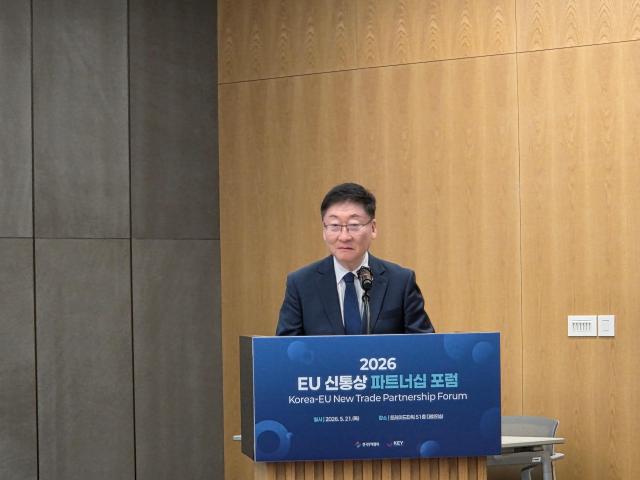
The forum was divided into two parts. The first part, titled "EU Sustainability Trends and Policy Regulation Outlook," featured a presentation by Walter Van Hatum, Trade and Economic Counselor at the EU Delegation to Korea, moderated by KEY Director Yoo Jae-hoon. The discussion included insights from Maeng Hak-kyun, a senior official at the Ministry of Climate, Energy, and Environment, lawyer Kim Hye-sung from Kim & Chang, and Lee Jung-woo, a director at Centennial Partners.
Van Hatum noted that the EU has reduced greenhouse gas emissions by approximately 37% since 1990, while the gross domestic product (GDP) has increased by about 60% during the same period. He emphasized that contrary to popular belief, it is possible to achieve both environmental sustainability and economic growth. However, he added, "The EU is fighting a lonely battle in the environmental sector," stressing the need for participation from major countries like Korea. He pointed out that the total economic cooperation scale, encompassing bilateral trade and investment between Korea and the EU, amounts to approximately 450 trillion won, indicating the necessity for Korea to strengthen economic cooperation with the EU through environmental policies.
Van Hatum specifically highlighted the EU's goal to reduce greenhouse gas emissions in the transportation sector by 90%, emphasizing the increasing importance of collaboration with Korea, a country strong in semiconductors, batteries, and hydrogen, and one that shares similar values.
In response, Maeng referenced President Lee Jae-myung's statement last year that "the transition to a carbon-neutral society is an unavoidable path for sustainable growth and a leap to becoming a global economic powerhouse, even if it entails some pain," indicating that the current government plans to take a more proactive approach to environmental policies.
The EU implemented the CBAM on January 1 of this year, requiring carbon emission certificates for six major industrial products produced outside the EU, including steel, aluminum, fertilizers, cement, hydrogen, and electricity. Starting in January 2028, the scope of CBAM will expand to include 180 final goods, such as refrigerators and washing machines. This has put Korean industries, which rely heavily on Europe as a major export market, in a precarious position.
In this context, lawyer Kim suggested that while the EU's environmental regulations offer a high degree of predictability, the diversity and complexity of supply chains necessitate the development of response strategies regarding regulatory interpretation and application standards.
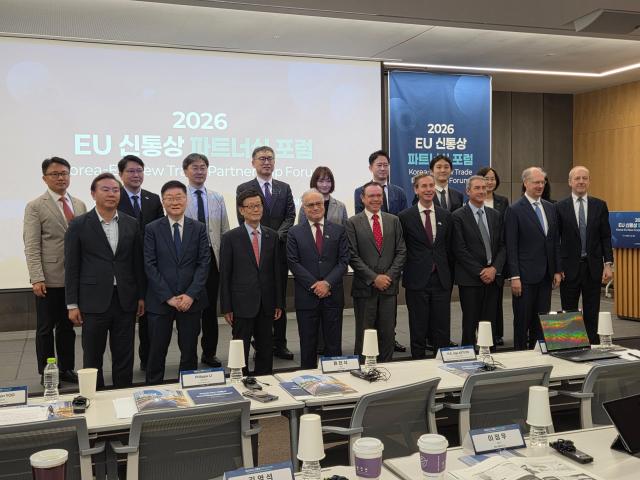
The second part, titled "Exemplary Cases of Sustainability Technology Innovation Companies," was moderated by Kim Yong-jae, an adjunct professor at Hanyang University. It included a presentation by Nicola Lejeune, Chief Technology Officer of Veolia Korea, along with discussions featuring Herve Pino, CEO of Veolia Korea, Kim Young-seok, CEO of Endress+Hauser Korea, Jang Han-young, team leader of the European and Climate Policy Team at LG Energy Solution, and Jang Hyun-sook, head of the New Trade Strategy Division at KITA.
Lejeune explained that since entering Korea in 1999, Veolia, a global environmental services company based in France, has provided carbon reduction and eco-friendly technology services to various sectors, including semiconductors, steel, petrochemicals, food and beverage, and pharmaceuticals. He introduced the company's key AI-based eco-friendly technology services, including digital cooling towers, real-time vibration monitoring, and biological wastewater treatment control.
Jang, the team leader at LG Energy Solution, discussed the preparations made to respond to the "battery passport" system, which the EU plans to implement in 2027. He noted that since this passport system involves information storage and sharing that extends beyond a single company, it is essential for the industry to review and establish a system collectively.
* This article has been translated by AI.
Copyright ⓒ Aju Press All rights reserved.