
After a decline, farm income successfully rebounded last year, while fisheries income decreased, reflecting mixed trends. Despite a record high seafood export of $3.33 billion last year, it did not significantly impact fisheries income.
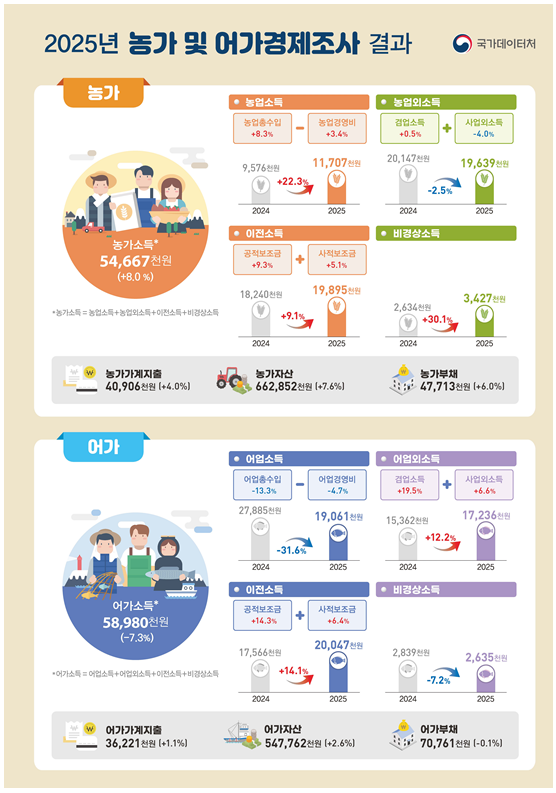
The National Data Agency released the "2025 Farm and Fisheries Economic Survey Results" on May 22. The average annual income for farms was reported at 54.67 million won, an 8.0% increase from the previous year. While agricultural income, transfer income, and non-regular income saw increases, income from non-agricultural sources declined.
Excluding agricultural management costs, the average agricultural income rose by 22.3% to 11.71 million won. Total agricultural income increased by 8.3% to 39.91 million won, driven by rises in crop income (1.1%) and livestock income (28.5%). Agricultural management costs also rose by 3.4% to 28.21 million won, attributed to increases in material costs (2.8%), labor costs (10.8%), and other expenses (2.6%).
While income from side businesses increased by 0.5%, income from non-business activities fell by 4.0%, leading to an overall decline of 2.5% in total non-agricultural income, which stood at 19.64 million won. Transfer income rose by 9.1% to 19.89 million won, and non-regular income increased by 30.1% to 3.43 million won.
Farmers reported average expenditures of 40.91 million won in 2025, with consumer spending rising by 3.3% to 32.14 million won and non-consumer spending increasing by 6.9% to 8.76 million won.
As of the end of last year, the average assets of farms were valued at 662.85 million won, with fixed assets at 550.22 million won and current assets at 112.63 million won.
Farmers carried an average debt of 47.71 million won, a 6.0% increase from the previous year.
Additionally, larger farm sizes correlated with higher income, though debt levels also increased. Farmers under 50 years old, as well as those aged 50-59 and 60-69, reported incomes, expenditures, assets, and debts above the average, while those over 70 had figures below the average.
In contrast, fisheries income, which reached a record high in 2024, shrank by 7.3%. The decline in aquaculture appears to have significantly impacted overall income.
The average annual income for fisheries was reported at 58.98 million won, down 7.3% from the previous year. While income from non-fishing activities and transfer income increased, fishing income and non-regular income saw substantial declines, pulling down total income.
In 2025, fishing income fell by 31.6% to 19.06 million won. Total fisheries income decreased by 13.3% to 76.11 million won, while fishing management costs decreased by 4.7% to 57.05 million won.
Fisheries reported average expenditures of 36.22 million won last year, with consumer spending at 27.89 million won and non-consumer spending at 8.33 million won.
The average assets of fisheries increased by 2.6% from 2024, reaching 547.76 million won, with fixed assets at 419.14 million won and current assets at 128.63 million won.
As of the end of last year, the average debt for fisheries was 70.76 million won, a slight decrease of 0.1% from the previous year.
Similar to farms, fisheries operated by managers under 50 years old, as well as those aged 50-59 and 60-69, reported higher income, expenditures, and assets than the average, while those over 70 fell below the average.
* This article has been translated by AI.
Copyright ⓒ Aju Press All rights reserved.