
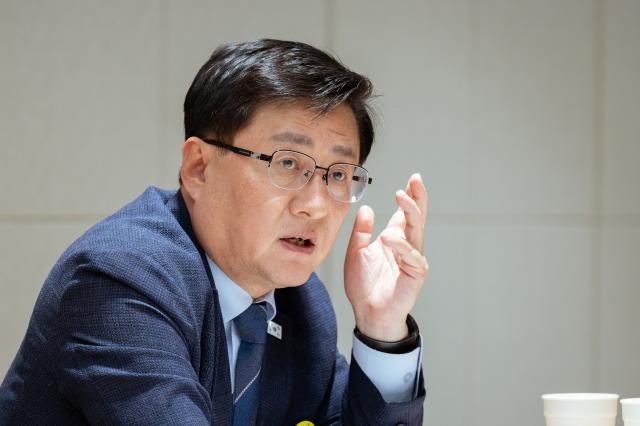
During his appearance on the YouTube program "Jang Yoon-sun's Convenience Store for Reporting," Kim discussed the energy price instability stemming from the prolonged conflict, noting, "We are beginning to see pressure from rising gas prices that could impact electricity rates."
He explained that the wholesale electricity price (SMP) was around 100 to 110 won before the conflict but has now risen to the mid-120 won range. He added, "If the annual average SMP exceeds 146 won, KEPCO will enter a loss-making structure."
However, he reassured that the current SMP is still below the threshold for losses, stating, "We are still maintaining a profit margin."
Kim emphasized that while there are no immediate signs of a shift to losses, the possibility cannot be ruled out if gas prices continue to rise. He stated, "Our task is to minimize the use of coal and gas while expanding nuclear and renewable energy to prevent increases in electricity rates."
He reiterated the importance of a dual energy policy that incorporates both renewable energy and nuclear power. He remarked, "During the Moon Jae-in and Yoon Suk Yeol administrations, renewable energy and nuclear power were often seen as conflicting, but this approach makes it difficult to reduce coal and gas usage. The key is to utilize both to establish a foundation for carbon reduction."
Regarding the expansion of electric vehicles, Kim noted, "Public institutions are already mostly required to purchase electric vehicles for new vehicle acquisitions," adding that preparations are underway to transition special vehicles such as police patrol cars and postal motorcycles and trucks to electric models. He mentioned that discussions are ongoing with relevant ministries to encourage electric vehicle purchases by corporations through differentiated cost handling methods.
Kim also introduced the 'Sunlight Income Village' project, a key energy policy of the Lee Jae-myung administration. He explained, "This year, we plan to pilot the project in about 700 to 1,000 villages, allowing residents to participate in solar energy projects through cooperatives and earn energy income."
He cited the example of Goyang-ri in Yeoju, where a 1 MW project generated approximately 10 million won in monthly communal profits, stating, "This could become a new rural basic income model that connects solar energy to residents' incomes."
On the topic of renewable energy pricing, he noted, "The costs for solar and wind power have significantly decreased compared to the past," with solar prices dropping to around 120 won and wind power to 108 won.
However, he diagnosed that the domestic industry has weakened due to aggressive pricing from Chinese imports and policy setbacks. Kim stated, "The solar industry has nearly stagnated during the three years of the Yoon Suk Yeol administration, causing the domestic industry to shrink. Although domestic modules are about 20% more expensive, they only account for about 20% of total generation costs, so we must promote both the development of the domestic industry and the expansion of renewable energy."
Additionally, he addressed environmental issues closely related to daily life, mentioning measures to control lovebug larvae. He stated, "We are currently piloting the use of bio-based agents for larvae control and plan to verify their effectiveness this year to decide on full-scale implementation next year."
* This article has been translated by AI.
Copyright ⓒ Aju Press All rights reserved.