
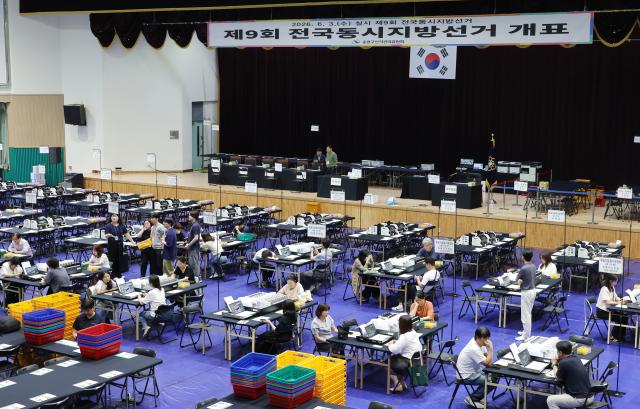
Officials demonstrate a ballot sorting machine at a counting center set up at Seoul Science and Technology University in Nowon-gu, Seoul, a day before the 9th nationwide local elections. [Photo=Yonhap News]
On June 3, approximately 44.65 million voters will participate in local elections and National Assembly by-elections. This election, held one year after the inauguration of the Lee government, serves as a significant midterm evaluation. The results are expected to either bolster or diminish the government's momentum. Additionally, the elections are closely tied to the restructuring of the ruling Democratic Party and the opposition People Power Party.
According to the National Election Commission, voting will take place simultaneously at 14,288 polling stations across the country from 6 a.m. to 6 p.m. A total of 4,241 positions will be filled, including 16 regional heads (mayors and governors) and 14 National Assembly members.
Voters will receive up to eight ballots in two rounds, depending on their region, including for positions such as regional heads, education superintendents, district heads, local assembly members, and National Assembly representatives. Some ballots may not be distributed if there are no by-elections or if candidates are elected unopposed.
Voters must use the tools provided at the polling station and can only mark one candidate on each ballot. Taking photos inside the polling station or of the ballots is prohibited, and those who intentionally damage ballots or take pictures of marked ballots may face penalties.
During the early voting period from May 29 to 30, 10,498,411 out of 44,649,908 registered voters participated, resulting in a record early voting turnout of 23.51%. If this trend continues, the final voter turnout may exceed the 50.9% recorded four years ago.
Key results for regional heads and National Assembly members are expected to emerge by midnight. However, in populous and competitive regions, counting may continue until 3 or 4 a.m.
Political analysts suggest that the election will significantly impact the future governance of the Lee administration, as it will be viewed as a midterm assessment of its first year. During the campaign, the ruling Democratic Party urged voters to "support the Lee government through your votes," while the opposition People Power Party called for an end to the "arrogance of the ruling party."
Noh Tae-ak, chairman of the National Election Commission, stated, "We will ensure that every precious vote is accurately reflected in the results, and we urge everyone to participate in this election, which can serve as a cornerstone for strengthening grassroots democracy."
According to the National Election Commission, voting will take place simultaneously at 14,288 polling stations across the country from 6 a.m. to 6 p.m. A total of 4,241 positions will be filled, including 16 regional heads (mayors and governors) and 14 National Assembly members.
Voters will receive up to eight ballots in two rounds, depending on their region, including for positions such as regional heads, education superintendents, district heads, local assembly members, and National Assembly representatives. Some ballots may not be distributed if there are no by-elections or if candidates are elected unopposed.
Voters must use the tools provided at the polling station and can only mark one candidate on each ballot. Taking photos inside the polling station or of the ballots is prohibited, and those who intentionally damage ballots or take pictures of marked ballots may face penalties.
During the early voting period from May 29 to 30, 10,498,411 out of 44,649,908 registered voters participated, resulting in a record early voting turnout of 23.51%. If this trend continues, the final voter turnout may exceed the 50.9% recorded four years ago.
Key results for regional heads and National Assembly members are expected to emerge by midnight. However, in populous and competitive regions, counting may continue until 3 or 4 a.m.
Political analysts suggest that the election will significantly impact the future governance of the Lee administration, as it will be viewed as a midterm assessment of its first year. During the campaign, the ruling Democratic Party urged voters to "support the Lee government through your votes," while the opposition People Power Party called for an end to the "arrogance of the ruling party."
Noh Tae-ak, chairman of the National Election Commission, stated, "We will ensure that every precious vote is accurately reflected in the results, and we urge everyone to participate in this election, which can serve as a cornerstone for strengthening grassroots democracy."
* This article has been translated by AI.
Copyright ⓒ Aju Press All rights reserved.