
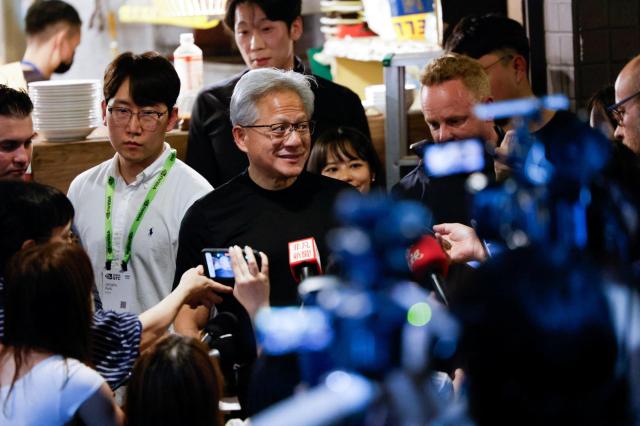
Jensen Huang, CEO of NVIDIA, is generating excitement in South Korea with his visit this week. News of his arrival or even a ceremonial first pitch at a baseball game has led to a surge in stock prices for companies associated with him over the past two days.
Huang's previous visit to South Korea last year demonstrated his significant influence. Following what was dubbed the "gangbu meeting," shares of companies like Samsung Electronics and Hyundai Motor soared. Notably, Samsung Electronics saw a more than 3% increase on June 2, even amid a broader market decline, ultimately surpassing Meta to become the 10th largest company globally by market capitalization. This achievement underscores the competitive strength of South Korean firms within the global AI supply chain and highlights Huang's impact as a leading figure in the graphics processing unit (GPU) market.
This situation emphasizes that talent remains the most critical factor in the ongoing AI industrial revolution. A fierce global competition for AI talent is underway, with major U.S. tech companies offering substantial financial incentives to attract top researchers. Meanwhile, China is preparing to implement restrictions on outbound personnel and foreign investments to prevent the loss of key talent and technology.
As the era of AI reshapes national competitiveness, securing talent has become a matter of survival for countries, not just corporations. The ability to acquire semiconductor and AI technologies will determine the industrial landscape and survival prospects for decades to come.
However, the reality in South Korea suggests that the rising stock market is not the only indicator of success. While the government is promoting policies to attract foreign talent, such as expanding the "top-tier visa" program, it still lags behind other advanced AI nations. According to a February report from the Software Policy Research Institute, South Korea ranks between 30th and 40th globally in terms of attractiveness for talent acquisition. Additionally, the Stanford AI Index report from last year indicated that South Korea ranks 35th among OECD countries for net outflow of AI talent, with 0.36 individuals leaving per 10,000 people.
In this context, recent developments following the resolution of wage negotiations at Samsung Electronics are significant. After the agreement, applications to semiconductor-related programs surged, and reports suggest that Samsung employees are now as desirable in the marriage market as professionals like lawyers. While salary alone does not drive talent decisions, competitive compensation is essential for attracting skilled individuals.
Huang also addressed questions about Samsung's bonuses, stating, "Employees should receive as much compensation as possible." His perspective is informed by his own experiences in Silicon Valley, where he built NVIDIA into a leading company after graduating from engineering school.
Last week, the South Korean team achieved a record performance at the Asia Physics Olympiad, winning eight gold medals. This success highlights the presence of exceptional scientific talent in the country. However, it has been noted that many students who excel in math and science competitions often choose to pursue medical degrees for economic reasons. If South Korea fails to connect its top scientific talent to the domestic AI and semiconductor industries, it could result in a national loss.
Of course, from a corporate perspective, increasing wages and bonuses can be burdensome and may negatively impact short-term profitability. However, in the long run, securing top talent is more of an investment than a cost, as the competitiveness of the AI era ultimately hinges on people.
To attract AI talent, it is crucial to foster an environment conducive to talent development. Therefore, the resolution of Samsung's wage negotiations should serve as a catalyst for the emergence of South Korea's own "Jensen Huang" and potentially the world's leading company by market capitalization. The government must also work on improving the overall system to support this goal.
* This article has been translated by AI.
Copyright ⓒ Aju Press All rights reserved.