

According to the financial investment industry on June 2, firms such as DS Asset Management, Life Asset Management, Daol Asset Management, and iM Asset Management are exploring entry or expansion into the ETF business. DS Asset Management has completed its ETF organizational setup by hiring Jeong Seong-in, who previously led the ETF business at Kiwoom Investment Management, and aims to launch an active ETF on the KOSDAQ by July. The firm plans to introduce up to three ETF products in the second half of the year.
Life Asset Management has applied for a public fund management license. Currently holding only a private fund license, the firm plans to enter the ETF market as soon as it receives approval for public funds. Daol Asset Management is also in the process of hiring staff with an eye on entering the ETF market. Meanwhile, iM Asset Management is reviewing the launch of new products after releasing a KOSPI 200 ETF in February of last year.
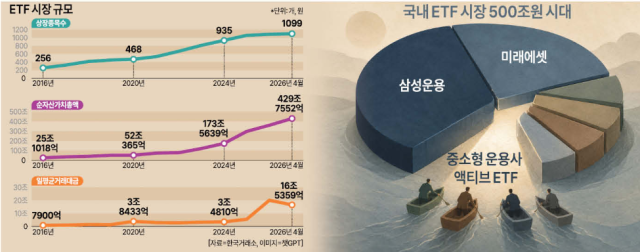
Just a few years ago, skepticism prevailed regarding the entry of small and mid-sized asset managers into the ETF market. The prevailing belief was that the business required economies of scale, making it difficult for latecomers to survive. Currently, Samsung Asset Management and Mirae Asset Management together hold a combined market share of 70% in the domestic ETF market.
Despite this, small and mid-sized firms cannot ignore the ETF market, as it has become a core business in asset management. With the ETF market capitalization exceeding 500 trillion won, it has emerged as a key vehicle for individual investors to channel significant funds into the stock market.
The growth of active ETFs is particularly encouraging smaller firms to enter the market. Unlike passive ETFs, which simply track an index, active ETFs allow fund managers' investment decisions to directly influence returns. Firms with extensive experience in private equity management are seen as well-positioned to identify specific industries or stocks and implement concentrated investment strategies through active ETFs.
Profitability is also an attractive factor. While scale competition is crucial in the ETF market, active ETFs can command relatively higher fees based on differentiated management performance. Investors, expecting higher returns, are generally less resistant to higher fees. The business model is shifting toward securing profitability based on management performance rather than competing solely on assets under management (AUM).
A notable example is Timefolio Asset Management. By focusing on active ETFs, Timefolio's market share jumped from 10th place at the end of 2024 to 7th place in March of this year. Its profitability has also significantly increased, with a net profit of 85.1 billion won for the 2025 fiscal year, a 145% rise from 34.7 billion won the previous year.
Industry experts believe that the performance of DS Asset Management will be a pivotal factor in determining the speed at which small and mid-sized firms enter the ETF market. Despite the increasing polarization in the ETF market, the emergence of additional success stories through active ETFs could lead to more private equity firms entering the ETF space.
An industry insider remarked, "In the past, the ETF market was seen as the domain of large firms, but now there is a new option with active ETFs. As firms with private equity management experience begin to incorporate their unique investment strategies into ETFs, the competitive landscape may gradually change."
* This article has been translated by AI.
Copyright ⓒ Aju Press All rights reserved.