
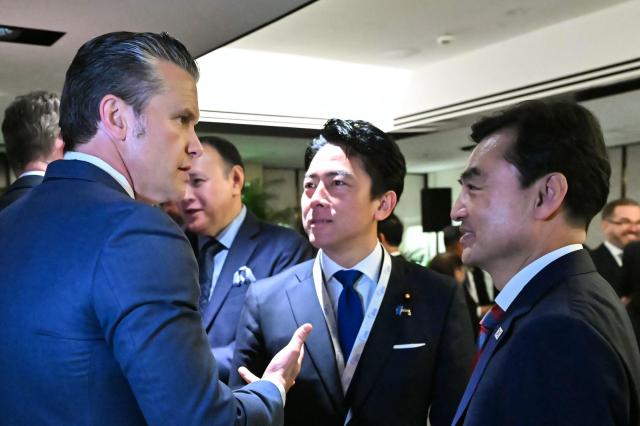
In recent discussions, China has criticized Japan's strengthening of its defense capabilities as a form of "new militarism." However, there are also positive sentiments regarding Japan's security role in the Asia-Pacific region. Amid concerns that U.S. engagement in the Indo-Pacific may waver, there is growing hope that Japan can help counter China and support regional stability, although fears persist that Japan's expanded military role could trigger an arms race in the region.
The Yomiuri Shimbun reported on May 31 that during the Shangri-La Dialogue, an Asian security conference held in Singapore, China's criticism of Japan as a "new militarism" did not resonate with other Asia-Pacific nations facing China's maritime expansion. Instead, there was a prevailing atmosphere that appreciated Japan's defense cooperation.
While China toned down its criticism of the U.S. at the conference, it continued its offensive against Japan. Meng Xiangqing, a professor at the National Defense University leading the Chinese delegation, questioned Japan's qualifications for international defense cooperation, stating, "Is a country that has not overcome militarism qualified to speak of defense cooperation?" Following Japanese Prime Minister Sanae Takaichi's remarks in the National Assembly regarding Taiwan, China has launched a media campaign portraying Japan as embodying "new militarism."
Contrary to China's assertions, reactions from the conference were different. Gilbert Teodoro, the Philippine Secretary of National Defense, criticized China for misusing history to unjustly malign Japan. He defended Japan, stating, "Japan is undoubtedly a model for the world."
Australia also emphasized the importance of expanding defense cooperation with Japan. Deputy Prime Minister and Defense Minister Richard Marles told reporters, "Operational cooperation with Japan has significantly increased." Australia is enhancing its defense collaboration with Japan, including the decision to introduce upgraded Mogami-class frigates into its Maritime Self-Defense Force.
Southeast Asian nations expect Japan to complement U.S. military presence in the region. The Asahi Shimbun reported on June 2 that former Singaporean Deputy Foreign Minister Bilahari Kausikan described Japan as an "anchor" supporting U.S. military presence in the Indo-Pacific. Southeast Asian countries, wary of leaning too heavily toward either the U.S. or China amid their rivalry, hope Japan can contribute to maintaining regional balance.
The Nihon Keizai Shimbun reported on May 31 that a survey conducted in April by the ISEAS-Yusof Ishak Institute among ASEAN experts revealed that for the first time in two years, more than half preferred China over the U.S. if forced to choose between the two. The strategic calculations of Southeast Asia are becoming increasingly complex due to U.S. prioritization and China's economic pressure.
While there are growing calls for Japan to expand its role, Southeast Asia is not fully embracing this shift. The Asahi Shimbun reported on June 2 that a senior ASEAN official expressed uncertainty about Japan's future direction in response to Defense Minister Shinjiro Koizumi's speech suggesting Japan's defense enhancement would contribute to regional stability, stating, "We do not want an arms race to escalate in this region." An official from an Indonesian think tank also pointed out that Japan has not adequately explained to Southeast Asian nations the reasons behind its military buildup.
Japan is pursuing a shift in its post-war security policy through the acquisition of counterstrike capabilities, increased defense spending, and expanded arms exports. The Japanese government explains these measures as responses to China's military expansion, North Korea's missile threats, and changes in the U.S. role. However, concerns remain among Asian nations that have experienced Japan's past aggression that Japan's military role expansion could provoke an arms race in the region.
As China's criticisms of Japan fail to gain significant traction, expectations for Japan's security role are growing. However, experts emphasize that for this role to foster regional trust, Japan must clearly communicate the objectives and direction of its defense enhancements to neighboring countries.
* This article has been translated by AI.
Copyright ⓒ Aju Press All rights reserved.