
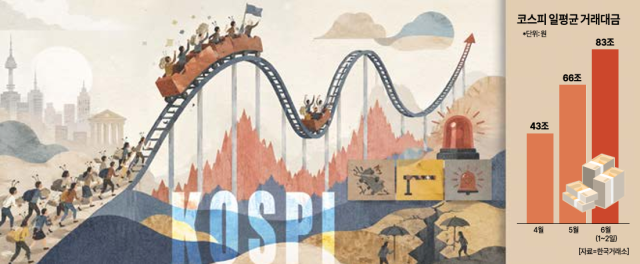
The KOSPI index has surpassed the 8,800 mark, reflecting unprecedented strength in the domestic stock market, accompanied by a significant increase in trading volume and heightened market volatility. A surge of funds from individual investors is driving the market upward, but signs of overheating are becoming evident, with mechanisms like sidecars and circuit breakers being activated to mitigate volatility.
According to the Korea Exchange, the average daily trading volume in the securities market for June 1-2 was approximately 83 trillion won. This figure is nearly double the average daily trading volume of 43 trillion won recorded in April, before the current upward trend began.
The buying momentum, primarily driven by individual investors, is contributing to both the increase in trading volume and the rise in stock prices. While foreign investors have been net sellers for 18 consecutive trading days, totaling 60 trillion won, individual investors have stepped in with about 47 trillion won in net purchases, supporting the index.
Market analysts attribute the recent surge in stock prices to a fear of missing out (FOMO) among investors. However, the rapid increase in trading volume and volatility is raising concerns. Recently, the KOSPI has experienced dramatic fluctuations, with intraday swings of several hundred points. The average difference between intraday highs and lows this month has reached 409 points, significantly up from 306 points last month and 134 points in April.
The activation of sidecars, a key indicator of market volatility, has surged this year, with a total of 20 activations in the KOSPI market, marking the first time in six months that sidecars have been triggered consecutively. This is only six activations short of the annual record of 26 set during the global financial crisis in 2008.
Circuit breakers, which temporarily halt all trading, have also been activated twice. This marks the first time since the COVID-19 pandemic in 2020 that circuit breakers have been triggered twice in a single month.
The use of volatility mitigation devices (VI) to ease sharp fluctuations in individual stocks is also on the rise. The KOSPI 200 Volatility Index (VKOSPI), often referred to as Korea's fear index, remains at elevated levels. On June 2, the VKOSPI peaked at 75.42 and has exceeded 75 for three consecutive trading days. Analysts warn that if volatility continues to expand, potential market shocks could lead to larger-than-expected declines.
Despite the recent increase in volatility, analysts do not interpret it as a signal of an impending downturn. Cho Chang-min, a researcher at Hyundai Motor Securities, noted, "This year, the average VKOSPI has exceeded 50 points, reaching an all-time high, but unlike in the past, we are seeing both rising indices and increasing volatility simultaneously. Typically, in a bull market, volatility tends to decrease, but we are currently experiencing an unusual market driven by liquidity and investor sentiment."
He added, "The current market is more akin to a trend with high volatility rather than a crisis phase. While volatility is increasing during the price rise, the price-to-earnings ratio remains at a historical low of 7.77, suggesting that a return to average valuations could enable the KOSPI to reach 10,000 points."
* This article has been translated by AI.
Copyright ⓒ Aju Press All rights reserved.