
The release of exit polls for the June 3 local elections has left both lawmakers and voters in confusion. The joint exit poll conducted by three major broadcasters—KBS, MBC, and SBS—presented a significantly different picture compared to predictions from JTBC. In some regions, the discrepancies were substantial, leading to mixed forecasts about the outcomes. Even before the counting began, many were questioning, "Which poll should we trust?"
According to the exit polls from the three broadcasters, the Democratic Party appears to be on track for a decisive victory.
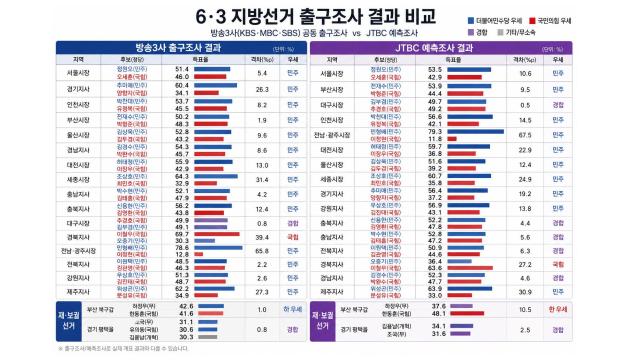
In the Seoul mayoral race, candidate Jeong Won-o garnered 51.4%, leading Oh Se-hoon, who received 46.0%, by 5.4 percentage points. In the Gyeonggi gubernatorial election, candidate Choo Mi-ae achieved 60.4%, significantly outpacing Yang Hyang-ja, who received 34.1%. The Incheon mayoral election also showed Park Chan-dae leading with 53.7% over Yoo Jeong-bok, who received 45.5%.
In Busan, candidate Jeon Jae-soo was projected to win with 50.2% against Park Hyung-jun's 48.3%, indicating a Democratic advantage. Similar forecasts for the Ulsan mayoral and Gyeongnam gubernatorial elections predicted victories for candidates Kim Sang-wook and Kim Kyung-soo, respectively.
Based solely on the three broadcasters' exit polls, the Democratic Party is interpreted as having a strong hold on the capital region, as well as making significant gains in the so-called PK region of Busan, Ulsan, and Gyeongnam. Some analysts even suggest that the party has seized the momentum in this nationwide election.
However, JTBC's predictions tell a different story.
While the Democratic Party maintained a lead in the Seoul, Busan, Incheon, and Gyeonggi races, JTBC classified five regions—Chungbuk, Chungnam, Gyeongnam, Jeonbuk, and Daegu—as competitive. Areas where the three broadcasters indicated a clear advantage for the Democratic Party were still considered toss-ups by JTBC.
For instance, in the Chungbuk gubernatorial race, the three broadcasters reported Shin Yong-han leading Kim Young-hwan by 12.4 percentage points, while JTBC viewed it as a competitive race with only a 4.4-point margin. Similarly, in the Gyeongnam gubernatorial election, the three broadcasters predicted Kim Kyung-soo leading by 8.6 points, while JTBC assessed it as a close contest with just a 4.6-point difference.
The discrepancies were also notable in the Gangwon gubernatorial race, where the three broadcasters projected a 2.6-point gap between Woo Sang-ho and Kim Jin-tae, while JTBC estimated a 13.8-point difference. The Seoul mayoral race also showed a divergence of over 5 percentage points between the two sources.
The most striking contrast emerged in the by-election for the Busan North Gap district. The three broadcasters reported Ha Jung-woo at 42.6% and Han Dong-hoon at 41.6%, indicating a narrow lead for Ha. However, JTBC predicted Han would secure 48.1% to Ha's 37.6%, flipping the expected outcome beyond mere statistical margins.
In the Gyeonggi Pyeongtaek election, the three broadcasters indicated a tight race among candidates Jo Guk, Yoo Yi-dong, and Kim Yong-nam, all around 30%, while JTBC forecasted Kim Yong-nam in the lead.
As a result, the political atmosphere remains cautious, with neither party eager to declare victory or concede defeat immediately following the exit poll announcements.
The Democratic Party may interpret the results from the three broadcasters as evidence of expanded influence in the capital region, Chungcheong, and parts of the PK region. Conversely, the People Power Party is focusing on the fact that many areas remain competitive according to JTBC, raising hopes for a potential turnaround.
Regions like Daegu, Chungbuk, Chungnam, Gyeongnam, and Jeonbuk are seen as critical battlegrounds for assessing future electoral dynamics. While the three broadcasters show a strong Democratic trend, JTBC suggests that the final results remain uncertain until the counting concludes. This divergence in interpretations of the same election underscores the complexity of the current political landscape.
Ultimately, the final answers will come from the counting results. Exit polls are important indicators of public sentiment, but instances of conflicting predictions from major broadcasters are rare. This local election is poised to be remembered not only for the outcomes for candidates but also for the accuracy of the exit polling organizations' forecasts.
* This article has been translated by AI.
Copyright ⓒ Aju Press All rights reserved.