
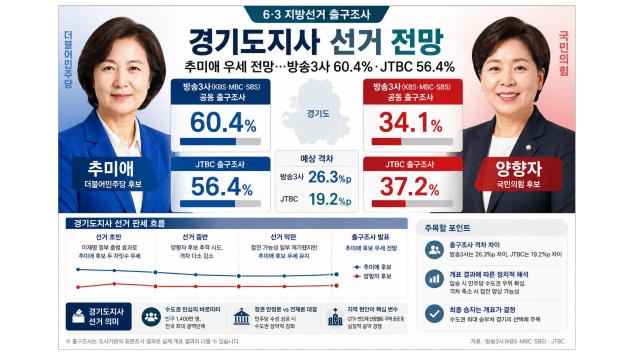
In one of the most competitive races of the local elections, Choo Mi-ae of the Democratic Party is projected to win the Gyeonggi Province governor election. Exit polls conducted by the three major broadcasting networks (KBS, MBC, and SBS) and predictions from JTBC indicate a strong likelihood of a Democratic victory in Gyeonggi Province.
According to the joint exit poll from the three broadcasting networks, Choo Mi-ae received 60.4%, significantly leading Yang Hyang-ja of the People Power Party, who garnered 34.1%, a difference of 26.3 percentage points.
JTBC's forecast also shows Choo Mi-ae at 56.4% and Yang Hyang-ja at 37.2%. Although the gap is narrower at 19.2 percentage points compared to the broadcasting networks' poll, Choo still maintains a double-digit lead.
Both polls agree on the direction of the results, indicating a likely victory for Choo Mi-ae. However, they differ in the margin of victory, with the broadcasting networks predicting a near landslide for the Democratic Party, while JTBC suggests a reduced gap.
Gyeonggi Province is the largest metropolitan local government in South Korea and is considered a barometer of public sentiment in the capital region. With a population exceeding 14 million, it has more voters than Seoul, making it a critical area for assessing the overall outcome of the local elections.
This election has drawn national attention from the outset. The Democratic Party emphasized the symbolic importance of retaining Gyeonggi Province, which is the political base of President Lee Jae-myung. Meanwhile, the People Power Party has focused its efforts on reclaiming Gyeonggi Province to shift public sentiment in the capital region.
Key issues during the campaign included transportation, housing, the expansion of the GTX transit system, the establishment of a semiconductor industry belt, and the creation of a northern special autonomous province. However, the national political landscape has also had a significant impact on the election dynamics.
From the beginning of the election, various opinion polls indicated that Choo Mi-ae maintained a lead. Although Yang Hyang-ja attempted to close the gap by appealing to centrist voters and those from the science and technology sectors, many analysts believe it was challenging to overturn the prevailing trend.
The exit poll results are interpreted as reflecting this ongoing trend.
Political analysts suggest that if the actual vote counts align closely with the exit polls, it would reaffirm the Democratic Party's clear advantage in the capital region. Given that Democratic candidates are also leading in the Seoul and Incheon mayoral races, it could indicate a reconfiguration of the political landscape in the capital region.
Conversely, the People Power Party is focusing on the relatively narrower gap reported by JTBC. If the actual vote percentages are lower than those predicted by the broadcasting networks, it may suggest that public sentiment in the capital region is not entirely leaning toward the Democratic Party.
Ultimately, attention is centered on how large Choo Mi-ae's margin of victory will be. The Gyeonggi Province governor election has become significant not just for the outcome itself, but for the implications of the victory margin on future political interpretations.
If the vote counts align with the exit polls, Choo Mi-ae would solidify the Democratic Party's governance in Gyeonggi Province while symbolically reaffirming the party's dominance in the capital region. The choice of Gyeonggi Province is expected to serve as a crucial benchmark for evaluating the overall results of this local election.
* This article has been translated by AI.
Copyright ⓒ Aju Press All rights reserved.