
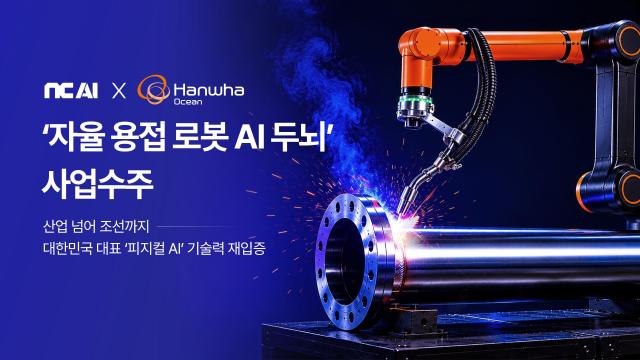
NC AI announced on June 4 that it has secured a contract with Hanwha Ocean to develop a vision recognition-based welding model and an autonomous welding model using collaborative robots.
This project aims to integrate advanced artificial intelligence (AI) vision recognition with precise robotic control technology for welding, a critical process in shipbuilding. NC AI and Hanwha Ocean are working towards implementing a "physical AI solution for autonomous welding" that enables robots to recognize and assess welding areas independently, performing optimal welding in real-time.
The welding process in shipyards presents extreme challenges for vision recognition AI due to intense arc light, sparks, real-time welding fumes, and camera lens contamination from outdoor and harsh environments. In arc welding, the temperature can rise from approximately 5,500 to 30,000 degrees Celsius, while plasma arc welding can reach ultra-high temperatures of up to 25,000 degrees Celsius.
To address these challenges, NC AI is conducting research that incorporates real-time feedback from Hanwha Ocean's actual worksite data and engineers. The goal is to develop a "shipbuilding-specialized vision recognition technology" that can accurately extract geometric welding lines and detect welding defects in real-time, even amidst strong noise and contamination.
NC AI is particularly emphasizing its advanced multimodal technology as the driving force behind this welding automation. This year, it plans to introduce the next-generation industry-specific vision language model, "VAETKI Vision," which is an upgraded version of last year's "VARCO VISION 2.0," as a key engine for the Hanwha Ocean project.
Lee Yeon-soo, CEO of NC AI, stated, "We aim to successfully develop robust vision recognition technology and autonomous control models that can overcome dust and contamination on-site, creating a world-class physical AI model that can be deployed in actual shipbuilding processes."
NC AI is particularly emphasizing its advanced multimodal technology as the driving force behind this welding automation. This year, it plans to introduce the next-generation industry-specific vision language model, "VAETKI Vision," which is an upgraded version of last year's "VARCO VISION 2.0," as a key engine for the Hanwha Ocean project.
Lee Yeon-soo, CEO of NC AI, stated, "We aim to successfully develop robust vision recognition technology and autonomous control models that can overcome dust and contamination on-site, creating a world-class physical AI model that can be deployed in actual shipbuilding processes."
* This article has been translated by AI.
Copyright ⓒ Aju Press All rights reserved.