
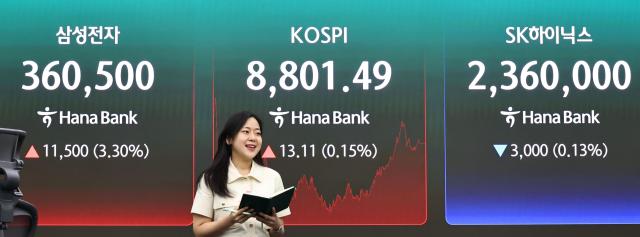
The New York Stock Exchange experienced a broad decline due to renewed geopolitical risks in the Middle East and instability in the private credit market, leading to increased risk aversion among investors. As a result, the domestic stock market is expected to show volatility in early trading, influenced by the U.S. market's adjustment and rising won-dollar exchange rates.
According to the financial investment industry on June 4, the Dow Jones Industrial Average fell by 1.21% on June 3 (local time), while the S&P 500 and Nasdaq dropped by 0.74% and 0.89%, respectively. Although semiconductor stocks remained relatively resilient, the ongoing military tensions between the U.S. and Iran, along with issues surrounding private loan fund redemptions, have led to an increase in risk premiums across the financial markets. Additionally, after a recent rally, profit-taking pressures have intensified.
Despite the existing upward trend centered on semiconductors, the domestic market is experiencing increased short-term volatility due to external factors. Notably, the KOSPI has shown significant fluctuations in intraday highs and lows, with perceived volatility outweighing directional trends.
As of 8:25 a.m., sector performance showed clear differentiation. Large-cap semiconductor stocks were under pressure, with Samsung Electronics down 1.11% at 356,500 won and SK Hynix falling 2.67% to 2,297,000 won. Other companies like SK Square (-3.19%) and Samsung Electro-Mechanics (-1.88%) also contributed to the index's downward pressure.
The automotive sector also faced notable declines, with Hyundai Motor dropping 3.43% to 704,000 won and Hyundai Mobis plunging 5.14%, marking the largest drop in the sector. This trend is interpreted as a reflection of concerns over global economic slowdown and supply-demand pressures.
Conversely, some sectors showed relative strength. LG Energy Solution rose 2.71%, indicating differentiation within the secondary battery sector, while HD Hyundai Heavy Industries surged 4.01%, leading gains in the shipbuilding industry. This is seen as a result of positive order momentum and expectations for the industry.
The financial and holding sectors generally exhibited weakness, with Samsung Life Insurance (-2.81%) and Samsung C&T (-1.75%) declining, reflecting a tendency to avoid riskier assets.
Overall, while the KOSPI maintains a long-term upward trend centered on semiconductors, short-term fluctuations driven by macroeconomic variables from the U.S., exchange rates, and sector-specific supply-demand imbalances are expected to persist, leading to a volatile market environment.
Han Ji-young, a researcher at Kiwoom Securities, stated, "The concentration on leading semiconductor stocks will continue, making high volatility unavoidable for the time being. However, it is reassuring to note that patterns of the market reducing losses toward the end of the trading day are frequently observed, indicating that the support for leading stocks remains strong."
* This article has been translated by AI.
Copyright ⓒ Aju Press All rights reserved.