
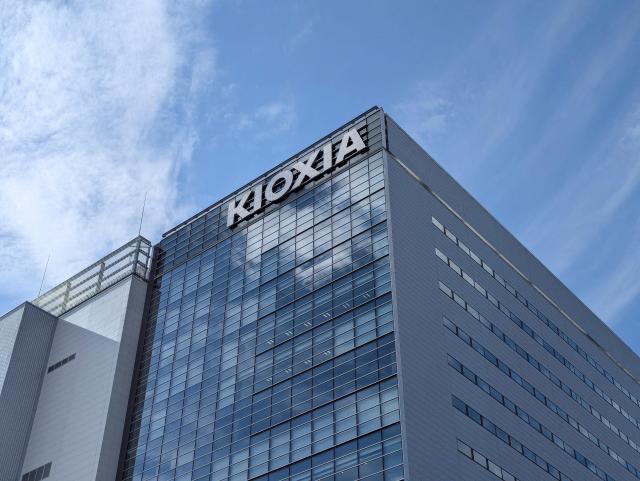
Japanese semiconductor memory company Kioxia Holdings is making a push into the NAND flash market for artificial intelligence (AI) servers. Although it lags behind competitors like Samsung Electronics and SK Hynix in terms of memory cell stacking, Kioxia aims to compete on read and write speeds by leveraging its unique technology that separates memory cells from control circuits before combining them.
According to the Nihon Keizai Shimbun (Nikkei), Kioxia is seeing improved performance driven by increased demand for memory in data centers, with its early adoption of substrate bonding technology leading to a rise in orders. During an investor briefing, Kioxia announced it would begin shipping samples of its next-generation NAND flash, referred to as the '10th generation,' this summer, with plans to increase the share of its enterprise sales, including data centers, to over 60% of total revenue. Atsushi Inoue, Kioxia's executive officer, stated, "We are achieving industry-leading performance and receiving high praise from many customers."
NAND flash is a type of memory semiconductor used for long-term data storage, and the key to technological competition has traditionally been how many memory cells can be stacked. Kioxia's predecessor, Toshiba, pioneered vertical stacking technology in 2007, but it has recently been perceived as falling behind in the stacking race. Kioxia announced in 2023 that it successfully developed 218-layer NAND, but the gap became more pronounced when SK Hynix revealed products exceeding 300 layers in the same year. Kioxia's flagship products remain at 218 layers.
The breakthrough for Kioxia is its CBA technology. While conventional NAND combines memory cells and control circuits on a single silicon wafer, CBA creates each on separate wafers and then precisely bonds them together. This process allows for more efficient use of wafer space and increases NAND storage density.
However, the process is complex, requiring near-perfect alignment of the two wafers and precise connections between the upper and lower layer circuits. Kioxia was the first to commercialize this technology. Kazuyoshi Saito, a senior analyst at Daiwa Securities, noted that Kioxia's NAND is 20-30% faster in read and write speeds compared to its competitors.
Initially, the reception was not entirely positive. When Kioxia announced CBA at the end of 2023, some in the industry viewed increasing stacking as the straightforward approach, arguing that CBA was unnecessarily complicated. However, as demand for NAND capable of quickly processing large amounts of data in AI servers grew, CBA began to gain attention for its speed advantages.
Moreover, competitors like Samsung and SK Hynix focused their investments on DRAM, which saw a surge in demand during the early AI boom, creating an opportunity for Kioxia, which has concentrated on NAND research and development, to differentiate itself in the AI server storage market.
Nevertheless, increasing market share will not be easy. According to Taiwanese research firm TrendForce, Kioxia held a 13.9% share of NAND sales by value from January to March this year, ranking third. Samsung led with a significant gap at 31.6%, while Micron and SanDisk also reached similar levels as Kioxia at 13.9%.
Kioxia's customer base in data centers is relatively weak, and the impact of NAND price increases appears to have been reflected later than for its competitors. Given that Samsung and SK Hynix have secured long-term contracts with major customers based on their supply capabilities, it will be challenging for Kioxia to significantly boost its market share in the short term.
Nonetheless, Nikkei views the shift in focus from stacking to processing speed in NAND competition, driven by the expansion of AI servers, as an opportunity. Analysts suggest that Kioxia's ability to secure data center customers with its CBA technology will be crucial for expanding its market share.
* This article has been translated by AI.
Copyright ⓒ Aju Press All rights reserved.