
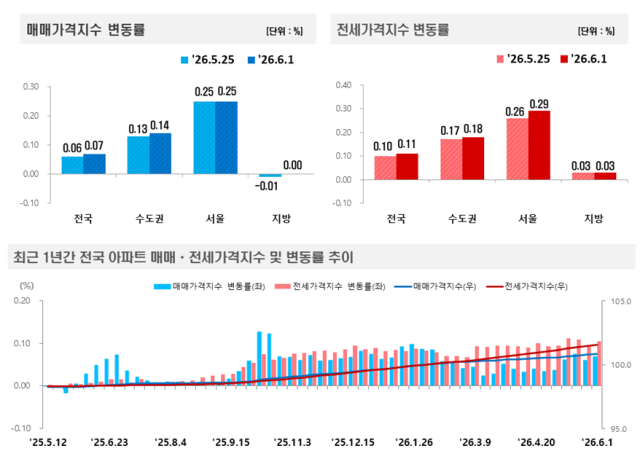
Apartment prices in Seoul have maintained a steady increase of 0.25% for six consecutive weeks, reflecting a strong trend in the metropolitan area. In Dongtan, Hwaseong, expectations surrounding the semiconductor industry have led to a significant surge of 0.60%, marking the highest increase nationwide, while other regions remained stable.
According to the Korea Real Estate Agency's report on nationwide apartment price trends for the first week of June, the average apartment sale price across the country rose by 0.07% compared to the previous week. The metropolitan area saw a 0.14% increase, with Seoul specifically rising by 0.25%, while other regions showed no change at 0.00%.
Despite a cautious buying sentiment in Seoul, transactions continued, particularly in newly built, large-scale, and transit-oriented developments, sustaining the upward trend. In the northern districts, Dongdaemun (0.37%), Seongdong (0.35%), Gangbuk (0.35%), and Seongbuk (0.34%) led the price increases. In the southern districts, Gangseo and Yeongdeungpo both rose by 0.31%, with Songpa (0.28%), Guro (0.27%), and Dongjak (0.25%) also experiencing gains.
In Gyeonggi Province, Dongtan in Hwaseong led the charge with a 0.60% increase. Gwangmyeong (0.43%) and Seongnam's Sujeong District (0.42%) also continued to rise in key residential areas. Conversely, Gwacheon (-0.19%) and Icheon (-0.16%) showed declines, particularly in large and established residential areas.
In Incheon, prices increased by 0.02%. Yeonsu District (0.06%) and Donggu and Michuhol Districts (each 0.04%) saw gains, while Namdong District (-0.02%) and Gyeyang District (-0.01%) faced declines.
The regional market displayed notable disparities. While Jeonbuk (0.07%) and Jeonnam (0.06%) experienced increases, Gwangju (-0.11%), Jeju (-0.04%), and Daegu and Daejeon (each -0.03%) saw decreases. As a result, overall prices in the provinces remained stable.
The rental market also continued its upward trend. Nationwide, apartment rental prices rose by 0.11%, with the metropolitan area increasing by 0.18% and Seoul by 0.29%. In Seoul, demand for rentals in educational districts, transit hubs, and large complexes remained steady, leading to an increase greater than the previous week's 0.26%.
In Seoul, Songpa District recorded the highest increase at 0.50%, followed by Seongdong (0.48%), Dobong (0.47%), Seongbuk (0.43%), and Nowon (0.41%). In Gyeonggi Province, Dongtan (0.37%), Gwangmyeong (0.34%), and Hanam (0.32%) showed notable increases.
Nam Hyuk-woo, a researcher at Woori Bank's Real Estate Research Institute, stated, "As expectations for improvements in the semiconductor industry grow, we are seeing a strong housing market in the southern Gyeonggi residential areas. In particular, the apartment market in Dongtan, which is well-connected by transportation and has excellent living conditions, is leading the upward trend." He added, "In northeastern Seoul, there is a relative shortage of rental and lease properties, and the increase in rental prices is significant. This has likely prompted some renters to shift to the buying market due to the rising rental costs."
* This article has been translated by AI.
Copyright ⓒ Aju Press All rights reserved.