
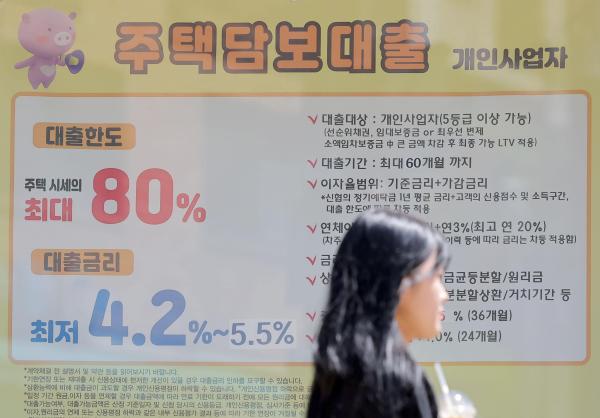
As the Bank of Korea formalizes its trend of increasing interest rates, borrowers are facing tough decisions. Typically, fixed-rate loans are preferred during periods of rising rates due to their stability, but current fixed rates are about 1 percentage point higher than variable rates. While variable rates are lower, they can lead to rapidly increasing principal and interest payments if rates rise further. So, which option is better for new borrowers?
According to financial sector data, the fixed-rate mortgage rates from the five major banks (KB Kookmin, Shinhan, Hana, Woori, and NH Nonghyup) are currently between 4.33% and 7.34%. This marks an increase from the previous month’s range of 4.26% to 7.10%, with the upper limit rising by 0.24%. Compared to the end of last year, when the upper limit was in the 6% range, this represents a jump of over 1 percentage point in just five months.
The sharp rise in fixed mortgage rates is attributed to an increase in the five-year bank bond rates, which serve as a benchmark for fixed rates. Bank bond rates reflect the costs banks incur when securing funds for loans. As market interest rates rise, bank bond rates increase, which subsequently affects loan rates after a delay.
Variable rates are also under upward pressure. According to the Bankers Association, the new CoFIX (Cost of Funds Index) for April was 2.89%, up 0.08 percentage points from the previous month. The balance-based CoFIX was 2.87%, and the new balance CoFIX was 2.49%, rising by 0.02 and 0.04 percentage points, respectively.
Generally, fixed rates are considered more favorable during periods of rising interest rates. Although the fixed rates are higher than variable rates, they allow borrowers to manage their finances more predictably due to the stability of fixed interest payments.
However, the current situation is complicated by the fact that fixed mortgage rates are now higher than variable rates. The variable mortgage rates from the five major banks are currently between 3.67% and 6.35%, with the upper limit nearly 1 percentage point lower than fixed rates.
As a result, many borrowers are opting for the lower initial payments associated with variable rates. According to the Bank of Korea, as of the end of April, the proportion of new variable-rate mortgages surged to 52.2%, an increase of 13 percentage points from the previous month. This means that more than half of the mortgages issued by banks are now variable rates, marking the first time since August 2021 that variable rates have exceeded 50%.
Given the likelihood of future rate hikes amid high inflation, banks advise borrowers to consider fixed rates for long-term financial stability. With mortgage terms typically lasting at least 30 years, reducing uncertainty is crucial.
Particularly with variable rates, interest rate increases are reflected periodically, which could lead to higher burdens for borrowers in the future. The Bank of Korea estimates that if loan rates rise by 0.25 percentage points, the total interest burden for borrowers would increase by 3.2 trillion won, and a 1 percentage point rise would add 12.8 trillion won. This translates to an average annual increase of 163,000 won in interest payments per borrower.
For those who find the high fixed rates burdensome, choosing a variable rate now and switching to a fixed rate after three years could be a viable strategy. After three years, borrowers can take advantage of a program that waives prepayment penalties when switching from a variable to a fixed rate.
A banking official stated, "In a situation where the Bank of Korea is expected to raise interest rates further, borrowers must weigh their current and future interest burdens. Since the rate hikes have not yet fully materialized, it may be strategically advantageous to monitor future rate trends before making a switch."
According to financial sector data, the fixed-rate mortgage rates from the five major banks (KB Kookmin, Shinhan, Hana, Woori, and NH Nonghyup) are currently between 4.33% and 7.34%. This marks an increase from the previous month’s range of 4.26% to 7.10%, with the upper limit rising by 0.24%. Compared to the end of last year, when the upper limit was in the 6% range, this represents a jump of over 1 percentage point in just five months.
The sharp rise in fixed mortgage rates is attributed to an increase in the five-year bank bond rates, which serve as a benchmark for fixed rates. Bank bond rates reflect the costs banks incur when securing funds for loans. As market interest rates rise, bank bond rates increase, which subsequently affects loan rates after a delay.
Variable rates are also under upward pressure. According to the Bankers Association, the new CoFIX (Cost of Funds Index) for April was 2.89%, up 0.08 percentage points from the previous month. The balance-based CoFIX was 2.87%, and the new balance CoFIX was 2.49%, rising by 0.02 and 0.04 percentage points, respectively.
Generally, fixed rates are considered more favorable during periods of rising interest rates. Although the fixed rates are higher than variable rates, they allow borrowers to manage their finances more predictably due to the stability of fixed interest payments.
However, the current situation is complicated by the fact that fixed mortgage rates are now higher than variable rates. The variable mortgage rates from the five major banks are currently between 3.67% and 6.35%, with the upper limit nearly 1 percentage point lower than fixed rates.
As a result, many borrowers are opting for the lower initial payments associated with variable rates. According to the Bank of Korea, as of the end of April, the proportion of new variable-rate mortgages surged to 52.2%, an increase of 13 percentage points from the previous month. This means that more than half of the mortgages issued by banks are now variable rates, marking the first time since August 2021 that variable rates have exceeded 50%.
Given the likelihood of future rate hikes amid high inflation, banks advise borrowers to consider fixed rates for long-term financial stability. With mortgage terms typically lasting at least 30 years, reducing uncertainty is crucial.
Particularly with variable rates, interest rate increases are reflected periodically, which could lead to higher burdens for borrowers in the future. The Bank of Korea estimates that if loan rates rise by 0.25 percentage points, the total interest burden for borrowers would increase by 3.2 trillion won, and a 1 percentage point rise would add 12.8 trillion won. This translates to an average annual increase of 163,000 won in interest payments per borrower.
For those who find the high fixed rates burdensome, choosing a variable rate now and switching to a fixed rate after three years could be a viable strategy. After three years, borrowers can take advantage of a program that waives prepayment penalties when switching from a variable to a fixed rate.
A banking official stated, "In a situation where the Bank of Korea is expected to raise interest rates further, borrowers must weigh their current and future interest burdens. Since the rate hikes have not yet fully materialized, it may be strategically advantageous to monitor future rate trends before making a switch."
* This article has been translated by AI.
Copyright ⓒ Aju Press All rights reserved.