
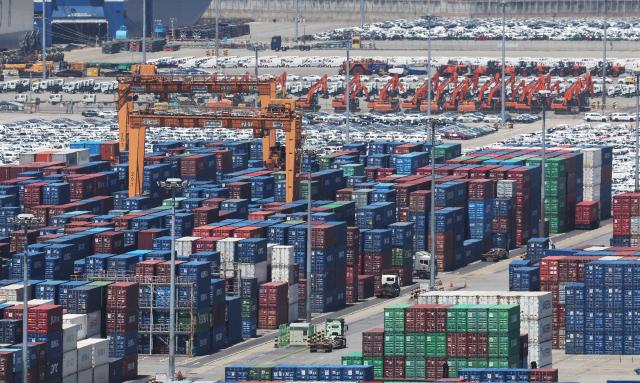
South Korea's ranking in effective tariff rates on exports to the United States has improved since the announcement of the U.S. reciprocal tariff policy in April of last year. In the second quarter of 2025, South Korea ranked third among the top 10 exporting countries to the U.S., but this dropped to sixth place in the first quarter of this year, indicating a reduction in tariff burden. The effective tariff rate is calculated by dividing the tariff amount by the U.S. import value.
According to an analysis of customs statistics by the Korea Chamber of Commerce and Industry (KCCI) on June 4, South Korea's exports to the U.S. in the first quarter of this year totaled $36.74 billion, with a tariff amount of $3.2 billion and an effective tariff rate of 8.7%. This rate is significantly lower than China's 26.4%. South Korea ranks sixth among the top 10 exporting countries to the U.S., following India (14.1%), Japan (11.2%), Germany (10.3%), and Vietnam (9.9%).
In the first quarter of this year, South Korea's tariff amount on exports to the U.S. was $3.2 billion, placing it seventh among the top 10 exporting countries. The implementation of a 10% general tariff on U.S. imports in April last year and item-specific tariffs on automobiles and parts (25%) and steel and aluminum (50%) peaked in the third quarter. However, following the conclusion of tariff negotiations between South Korea and the U.S. and a reduction in automobile tariffs to 15% in November last year, the burden has decreased. Compared to China, which recorded a tariff amount of $16.58 billion on exports to the U.S., South Korea's performance appears relatively favorable.
The effective tariff rate for the automobile sector, which has the highest proportion of tariff amounts among export items, fell significantly from 21.3% in the second quarter of last year to 13.5% in the first quarter of this year. Conversely, the effective tariff rate for steel and steel products, which has the second-highest tariff amount, increased to 42.5% in the first quarter of this year due to the implementation of a 50% item-specific tariff in June last year.
In terms of automobile tariffs, South Korea experienced a delay in the application of reductions compared to Germany and Japan. As a result, in the fourth quarter of last year, the gap widened with Germany and Japan, but by the first quarter of this year, South Korea's rate was higher than Japan's (12.5%) but lower than Germany's (14.5%).
Regarding steel tariffs, South Korea's low export proportion of raw materials such as pig iron and ferroalloy to the U.S. (only 2%) has resulted in high rates. In contrast, Brazil has a lower effective tariff rate of 20%, attributed to its 52% share of pig iron and ferroalloy in U.S. steel exports, which benefits from lower rates.
While it is true that South Korea's tariff burden has eased, uncertainties remain due to the potential for changes in U.S. tariff policy and the still high steel tariff rates. The KCCI stated, "Close monitoring of Section 232 tariff measures related to key export items such as semiconductors is necessary, along with ongoing diplomatic support from the government to resolve tariff uncertainties."
It also emphasized the need for policy support to protect domestic production bases and maintain competitiveness in the global market, stating, "Support to enhance our companies' price competitiveness, such as domestic production tax credits and strengthened export financing, should continue, alongside efforts to enhance capabilities through AI transformation in manufacturing over the medium to long term."
* This article has been translated by AI.
Copyright ⓒ Aju Press All rights reserved.